Ch.22 - The Main Group Elements
McMurry - Chemistry 8th Edition
McMurry8th EditionChemistryISBN: 9781292336145당신이 사용하는 게 아니라요?교과서 변경
22장, 문제 22.9

Which of the following oxides will be more soluble in acidic solution? (LO 22.14)
(a) SiO2 (b) NO2
(c) BaO (d) B2O3

검증된 단계별 안내
1
Identify the nature of each oxide: acidic, basic, or amphoteric.
Recall that basic oxides are more soluble in acidic solutions due to acid-base reactions.
Determine the nature of each oxide: SiO2 is acidic, NO2 is acidic, BaO is basic, and B2O3 is acidic.
Recognize that BaO, being a basic oxide, will react with an acidic solution to form a salt and water.
Conclude that BaO will be more soluble in an acidic solution compared to the other oxides.

비슷한 문제에 대한 검증된 영상 답변:

이 영상 해법은 위 문제에 도움이 된다고 튜터들이 추천한 것입니다.
도움이 되었나요?

주요 개념

질문에 올바르게 답하기 위해 반드시 이해해야 하는 핵심 개념들은 다음과 같습니다.

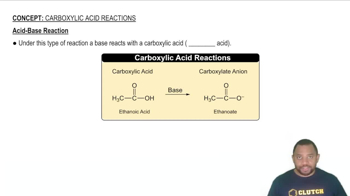
Acid-Base Reactions

Acid-base reactions involve the transfer of protons (H+) between reactants. In the context of oxides, acidic solutions can react with basic oxides to form soluble salts and water. Understanding the nature of the oxide—whether it behaves as an acid or a base—helps predict its solubility in acidic conditions.
추천 영상:
가이드 코스
01:09
Acid-Base Reaction

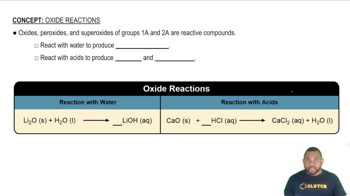
Solubility of Metal Oxides

The solubility of metal oxides in acidic solutions often depends on the metal's oxidation state and the oxide's basicity. Basic oxides, such as BaO, typically react with acids to form soluble salts, while amphoteric oxides, like B2O3, can react with both acids and bases, influencing their solubility in acidic environments.
추천 영상:
가이드 코스
00:58
Oxide Reactions

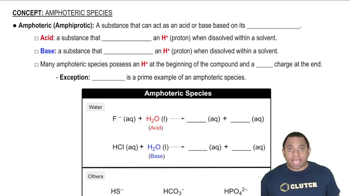
Amphoteric Behavior

Amphoteric oxides can react with both acids and bases, exhibiting dual behavior. For example, B2O3 can dissolve in acidic solutions, while SiO2 is generally considered insoluble. Recognizing which oxides are amphoteric is crucial for determining their solubility in acidic conditions.
추천 영상:
가이드 코스
03:03
Amphoteric Species