Ch.22 - The Main Group Elements
McMurry - Chemistry 8th Edition
McMurry8th EditionChemistryISBN: 9781292336145당신이 사용하는 게 아니라요?교과서 변경
22장, 문제 22.85

Explain why the properties of boron differ so markedly from the properties of the other group 3A elements.

검증된 단계별 안내
1
Step 1: Understand the periodic table. The periodic table is organized in such a way that elements with similar properties are grouped together. Boron is in Group 3A, along with aluminum, gallium, indium, and thallium.
Step 2: Consider the atomic structure. Boron has an atomic number of 5, which means it has 5 protons and, in its neutral state, 5 electrons. These electrons are arranged in two energy levels: 2 in the first level and 3 in the second. This configuration is different from the other elements in Group 3A, which have more energy levels and more electrons.
Step 3: Consider the size of the atom. Boron is a relatively small atom compared to the other elements in Group 3A. This means that the electrons are closer to the nucleus and more strongly attracted to it, which affects the chemical properties of the element.
Step 4: Consider the type of bonding. Boron is a metalloid, which means it has properties of both metals and nonmetals. It forms covalent bonds, unlike the other elements in Group 3A, which are metals and form ionic bonds.
Step 5: Consider the electron deficiency. Boron has fewer electrons than it has orbitals available for bonding, making it electron deficient. This leads to the formation of compounds with unusual structures and properties, further distinguishing boron from the other elements in Group 3A.

비슷한 문제에 대한 검증된 영상 답변:

이 영상 해법은 위 문제에 도움이 된다고 튜터들이 추천한 것입니다.
도움이 되었나요?

주요 개념

질문에 올바르게 답하기 위해 반드시 이해해야 하는 핵심 개념들은 다음과 같습니다.

Group 3A Elements

Group 3A elements, also known as Group 13 in the periodic table, include boron, aluminum, gallium, indium, and thallium. These elements share similar valence electron configurations, typically having three electrons in their outer shell. However, their properties can vary significantly due to differences in atomic size, electronegativity, and the presence of d-orbitals in heavier elements, which influence their chemical behavior.
추천 영상:
가이드 코스
01:25
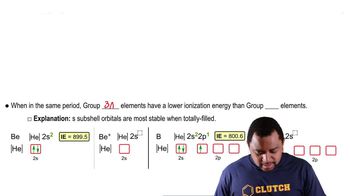
Group 3A vs. Group 2A Elements

Boron’s Unique Properties

Boron is a metalloid, which gives it distinct properties compared to the metals in Group 3A. It has a high melting point, is a poor conductor of electricity, and forms covalent compounds, unlike the more metallic character of aluminum and other heavier elements. Boron's small atomic size and high ionization energy contribute to its unique behavior, making it less reactive and more stable in certain compounds.
추천 영상:
가이드 코스
01:14
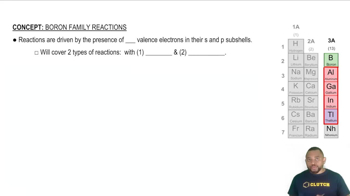
Boron Family Reactions

Chemical Bonding and Structure

The type of bonding and molecular structure significantly influence the properties of elements. Boron often forms covalent bonds and complex structures like boranes, which are different from the ionic or metallic bonding seen in aluminum and other heavier Group 3A elements. This difference in bonding leads to variations in physical properties such as hardness, melting points, and reactivity.
추천 영상: