Ch.3 - Mass Relationships in Chemical Reactions
McMurry - Chemistry 8th Edition
McMurry8th EditionChemistryISBN: 9781292336145당신이 사용하는 게 아니라요?교과서 변경
3장, 문제 110

Assume that gasoline has the formula C8H18 and has a density of 0.703 g/mL. How many pounds of CO2 are produced from the complete combustion of 1.00 gal of gasoline?

검증된 단계별 안내
1
Step 1: Convert the volume of gasoline from gallons to milliliters. Use the conversion factor 1 gallon = 3785.41 mL.
Step 2: Calculate the mass of gasoline in grams using the given density (0.703 g/mL).
Step 3: Convert the mass of gasoline from grams to moles using the molar mass of C8H18. The molar mass of C8H18 is approximately 114.22 g/mol.
Step 4: Use the balanced chemical equation for the combustion of gasoline to determine the moles of CO2 produced. The balanced equation is C8H18 + 12.5O2 -> 8CO2 + 9H2O. From this equation, we can see that 8 moles of CO2 are produced for every mole of C8H18.
Step 5: Convert the moles of CO2 to grams using the molar mass of CO2 (approximately 44.01 g/mol), and then convert grams to pounds using the conversion factor 1 lb = 453.592 g.

비슷한 문제에 대한 검증된 영상 답변:

이 영상 해법은 위 문제에 도움이 된다고 튜터들이 추천한 것입니다.
영상 길이:
7m

주요 개념

질문에 올바르게 답하기 위해 반드시 이해해야 하는 핵심 개념들은 다음과 같습니다.

Combustion Reaction

A combustion reaction is a chemical process in which a substance reacts with oxygen to produce heat and light. In the case of hydrocarbons like gasoline (C8H18), complete combustion yields carbon dioxide (CO2) and water (H2O). Understanding the stoichiometry of this reaction is essential for calculating the amount of CO2 produced from a given quantity of gasoline.
추천 영상:
가이드 코스
02:24
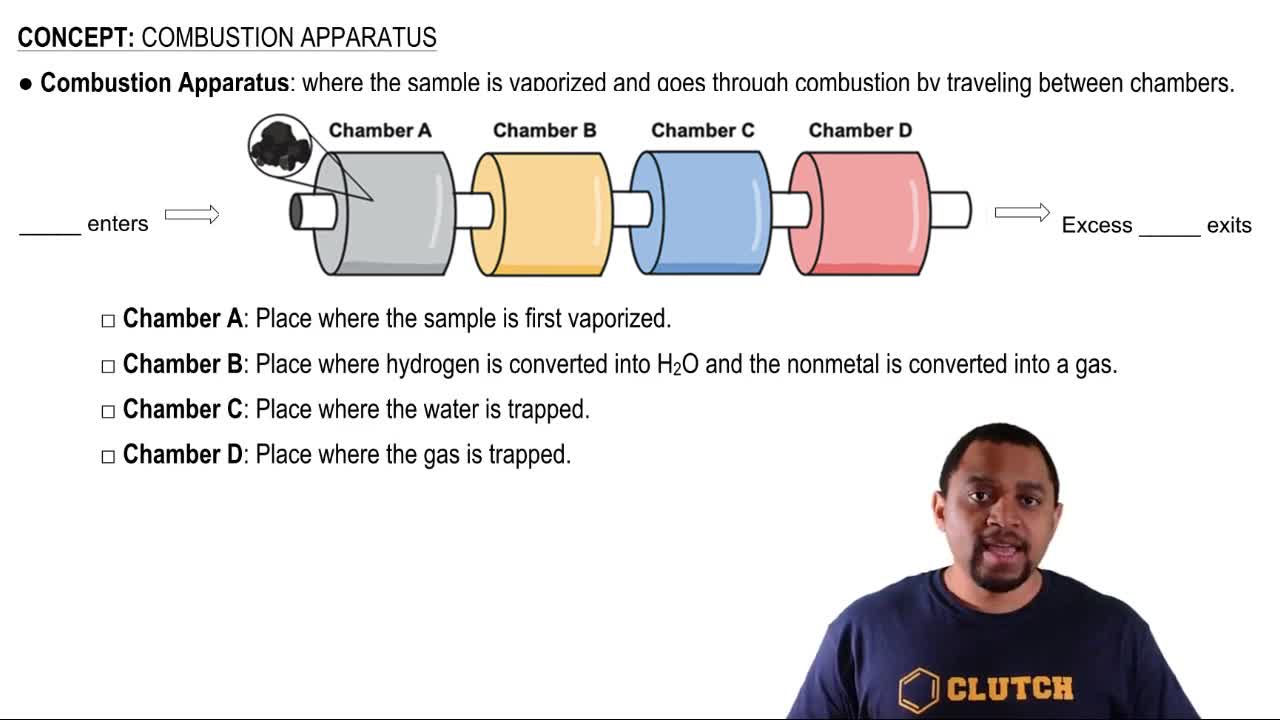
Combustion Apparatus

Stoichiometry

Stoichiometry is the calculation of reactants and products in chemical reactions based on the balanced chemical equation. It allows us to determine the relationships between the quantities of substances involved. For the combustion of C8H18, knowing the molar ratios from the balanced equation is crucial for converting the amount of gasoline into the corresponding amount of CO2 produced.
추천 영상:
가이드 코스
01:16
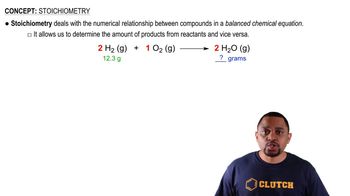
Stoichiometry Concept

Density and Volume Conversion

Density is defined as mass per unit volume and is crucial for converting between volume and mass. In this problem, the density of gasoline (0.703 g/mL) allows us to convert the volume of gasoline (1.00 gal) into grams. This conversion is necessary to relate the mass of gasoline to the amount of CO2 produced through stoichiometric calculations.
추천 영상:
가이드 코스
05:30
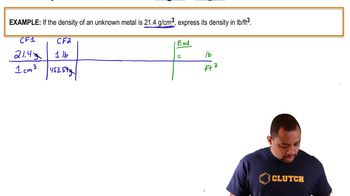
Density Conversion Example
관련 실천
교과서 질문

b) Given the mass spectrum of benzene, identify the molecular weight and give the molecular formula.

468
views

교과서 질문
(a) Combustion analysis of 150.0 mg of 1,2,3,benzenetriol, a compound composed of carbon, hydrogen, and oxy-gen, gives 64.3 mg of H2O and 314.2 mg of CO2. What is the empirical formula of 1,2,3,benzenetriol?
507
views
교과서 질문
A pulverized rock sample believed to be pure calcium carbonate, CaCO3, is subjected to chemical analysis and found to contain 51.3% Ca, 7.7% C, and 41.0% O by mass. Why can't this rock sample be pure CaCO3?
831
views
교과서 질문
A certain alcoholic beverage contains only ethanol (C2H6O) and water. When a sample of this beverage undergoes com-bustion, the ethanol burns but the water simply evaporates and is collected along with the water produced by combus-tion. The combustion reaction is When a 10.00 g sample of this beverage is burned, 11.27 g of water is collected. What is the mass in grams of ethanol, and what is the mass of water in the original sample?
709
views
교과서 질문
Compound X contains only carbon, hydrogen, nitrogen, and chlorine. When 1.00 g of X is dissolved in water and allowed to react with excess silver nitrate, AgNO3, all the chlorine in X reacts and 1.95 g of solid AgCl is formed. When 1.00 g of X undergoes complete combustion, 0.900 g of CO2 and 0.735 g of H2O are formed. What is the empirical formula of X?
1400
views
1
rank
2
comments
교과서 질문

The molecular weight of ethylene glycol is 62.0689 when calculated using the atomic weights found in a standard periodic table, yet the molecular weight determined experimentally by high-resolution mass spectrometry is 62.0368. Explain the discrepancy.

1674
views