Nickel(II) sulfate, used for nickel plating, is prepared by treat-ment of nickel(II) carbonate with sulfuric acid: NiCO3 + H2SO4 → NiSO4 + CO2 + H2O (a) How many grams of H2SO4 are needed to react with 14.5 g of NiCO3?
Ch.3 - Mass Relationships in Chemical Reactions
3장, 문제 73b
Hydrazine, N2H4, once used as a rocket propellant, reacts with oxygen: N2H4 + O2 → N2 + 2 H2O (b) How many grams of N2 are obtained if the yield is 85.5%?
검증된 단계별 안내1
Identify the balanced chemical equation: N_2H_4 + O_2 \(\rightarrow\) N_2 + 2 H_2O.
Determine the molar mass of N_2H_4 and N_2 using the periodic table.
Calculate the theoretical yield of N_2 in moles based on the stoichiometry of the balanced equation.
Convert the theoretical yield of N_2 from moles to grams using its molar mass.
Calculate the actual yield of N_2 by multiplying the theoretical yield in grams by the percentage yield (85.5%).

비슷한 문제에 대한 검증된 영상 답변:
이 영상 해법은 위 문제에 도움이 된다고 튜터들이 추천한 것입니다.
영상 길이:
6m주요 개념
질문에 올바르게 답하기 위해 반드시 이해해야 하는 핵심 개념들은 다음과 같습니다.
Stoichiometry
Stoichiometry is the calculation of reactants and products in chemical reactions based on the balanced chemical equation. It allows us to determine the amount of product formed from a given amount of reactant, using mole ratios derived from the coefficients in the balanced equation. In this case, understanding the stoichiometric relationship between hydrazine and nitrogen is essential to calculate the theoretical yield of N2.
추천 영상:
가이드 코스
Stoichiometry Concept
Percent Yield
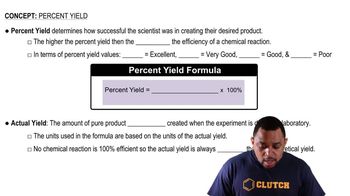
Percent yield is a measure of the efficiency of a chemical reaction, calculated by comparing the actual yield of a product to the theoretical yield. It is expressed as a percentage and is crucial for understanding how much of the expected product is actually produced in practice. In this question, the yield of 85.5% indicates that only a portion of the theoretical amount of N2 is obtained, which must be factored into the final calculation.
추천 영상:
가이드 코스
Percent Yield in Reactions
Molar Mass
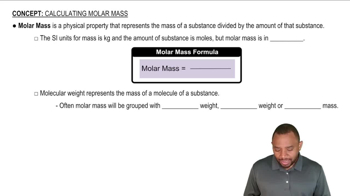
Molar mass is the mass of one mole of a substance, typically expressed in grams per mole (g/mol). It is essential for converting between moles and grams in stoichiometric calculations. For this question, knowing the molar mass of nitrogen (N2) is necessary to convert the amount of nitrogen produced from moles to grams, allowing for the final answer to be expressed in grams.
추천 영상:
가이드 코스
Molar Mass Concept
관련 실천
교과서 질문
1044
views
교과서 질문
Assume that you have 1.39 mol of H2 and 3.44 mol of N2. How many grams of ammonia (NH3) can you make, and how many grams of which reactant will be left over?
3 H2 + N2 --> NH3
1404
views
교과서 질문
Nickel(II) sulfate, used for nickel plating, is prepared by treat-ment of nickel(II) carbonate with sulfuric acid: NiCO3 + H2SO4 → NiSO4 + CO2 + H2O
(b) How many grams of NiSO4 are obtained if the yield is 78.9%?
962
views
교과서 질문
Hydrogen and chlorine react to yield hydrogen chloride: H2 + Cl2 ¡ 2 HCl. How many grams of HCl are formed from reaction of 3.56 g of H2 with 8.94 g of Cl2? Which reactant is limiting?
2471
views
교과서 질문
Hydrazine, N2H4, once used as a rocket propellant, reacts with oxygen: N2H4 + O2 → N2 + 2 H2O (a) How many grams of O2 are needed to react with 50.0 g of N2H4?
1276
views
교과서 질문
How many grams of the dry-cleaning solvent 1,2-dichloroethane (also called ethylene chloride), C2H4Cl2, can be prepared by reaction of 15.4 g of ethylene, C2H4, with 3.74 g of Cl2?
702
views