Ch.4 - Reactions in Aqueous Solution
McMurry - Chemistry 8th Edition
McMurry8th EditionChemistryISBN: 9781292336145당신이 사용하는 게 아니라요?교과서 변경
4장, 문제 73

Ethylene glycol, C2H6O2, is the principal constituent of auto-mobile antifreeze. If the density of a 40.0 mass % solution of ethylene glycol in water is 1.0514 g/mL at 20 °C, what is the molarity?

검증된 단계별 안내
1
Step 1: Understand the problem. We are given a 40.0 mass % solution of ethylene glycol in water. This means that in a 100 g solution, there are 40 g of ethylene glycol and 60 g of water. We are also given the density of the solution, which is 1.0514 g/mL.
Step 2: Calculate the volume of the solution. Since we know the density and the mass of the solution, we can use the formula for density (density = mass/volume) to find the volume. The mass of the solution is 100 g (40 g of ethylene glycol + 60 g of water) and the density is 1.0514 g/mL. Rearranging the formula gives volume = mass/density.
Step 3: Convert the mass of ethylene glycol to moles. We know that the molar mass of ethylene glycol (C2H6O2) is approximately 62.07 g/mol. So, we can use the formula moles = mass/molar mass to find the number of moles of ethylene glycol.
Step 4: Calculate the molarity of the solution. Molarity is defined as the number of moles of solute (in this case, ethylene glycol) divided by the volume of the solution (in liters). So, use the formula Molarity = moles/volume to find the molarity of the solution.
Step 5: Remember to convert the volume of the solution from mL to L before calculating the molarity, as molarity is typically expressed in moles/L.

비슷한 문제에 대한 검증된 영상 답변:

이 영상 해법은 위 문제에 도움이 된다고 튜터들이 추천한 것입니다.
영상 길이:
2m

주요 개념

질문에 올바르게 답하기 위해 반드시 이해해야 하는 핵심 개념들은 다음과 같습니다.

Molarity

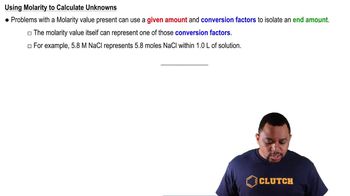
Molarity is a measure of concentration defined as the number of moles of solute per liter of solution. It is expressed in units of moles per liter (mol/L). To calculate molarity, one must know the amount of solute in moles and the total volume of the solution in liters. This concept is crucial for understanding how concentrated a solution is and for performing stoichiometric calculations in chemical reactions.
추천 영상:

Density

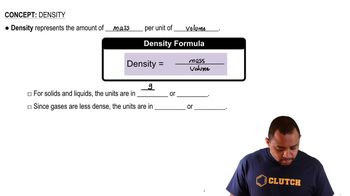
Density is defined as mass per unit volume, typically expressed in grams per milliliter (g/mL) or kilograms per cubic meter (kg/m³). In this context, the density of the solution helps determine the total volume of the solution when the mass of the solution is known. Understanding density is essential for converting between mass and volume, which is necessary for calculating molarity.
추천 영상:
가이드 코스
01:56
Density Concepts

Mass Percent Concentration

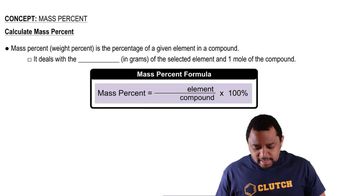
Mass percent concentration is a way to express the concentration of a solution, calculated as the mass of the solute divided by the total mass of the solution, multiplied by 100. In this case, a 40.0 mass % solution of ethylene glycol means that 40 grams of ethylene glycol are present in every 100 grams of the solution. This concept is important for determining the amount of solute in a given mass of solution, which is a key step in calculating molarity.
추천 영상:
가이드 코스
00:38
Mass Percent Calculation