Ch.4 - Reactions in Aqueous Solution
McMurry - Chemistry 8th Edition
McMurry8th EditionChemistryISBN: 9781292336145당신이 사용하는 게 아니라요?교과서 변경
4장, 문제 137a

Some metals occur naturally in their elemental state while others occur as compounds in ores. Gold, for instance, is found as the free metal; mercury is obtained by heating mercury(II) sulfide ore in oxygen; and zinc is obtained by heating zinc(II) oxide ore with coke (carbon). Judging from their positions in the activity series, which of the metals sil-ver, platinum, and chromium would probably be obtained by (a) finding it in its elemental state?

검증된 단계별 안내
1
insert step 1: Understand the activity series concept. The activity series is a list of metals ranked by their reactivity. Metals higher in the series are more reactive and are more likely to be found in compounds, while those lower in the series are less reactive and more likely to be found in their elemental state.
insert step 2: Identify the positions of silver, platinum, and chromium in the activity series. Typically, platinum is one of the least reactive metals, followed by silver, while chromium is more reactive.
insert step 3: Analyze the reactivity of each metal. Since platinum is very low in the activity series, it is less likely to react with other elements and more likely to be found in its elemental state.
insert step 4: Compare the reactivity of silver and chromium. Silver is less reactive than chromium, meaning it is more likely to be found in its elemental state than chromium.
insert step 5: Conclude that, based on their positions in the activity series, platinum is the most likely to be found in its elemental state, followed by silver, and chromium is the least likely.

비슷한 문제에 대한 검증된 영상 답변:

이 영상 해법은 위 문제에 도움이 된다고 튜터들이 추천한 것입니다.
영상 길이:
3m
도움이 되었나요?

주요 개념

질문에 올바르게 답하기 위해 반드시 이해해야 하는 핵심 개념들은 다음과 같습니다.

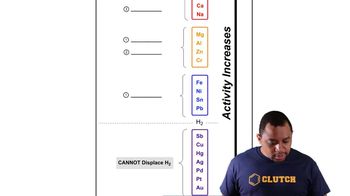
Activity Series of Metals

The activity series is a list of metals ranked by their reactivity, with the most reactive metals at the top and the least reactive at the bottom. This series helps predict how metals will react with other substances, including their likelihood of being found in their elemental state. Metals higher in the series tend to be more reactive and are usually found in compounds, while those lower in the series are more likely to be found as free metals.
추천 영상:
가이드 코스
02:02
Activity Series Chart

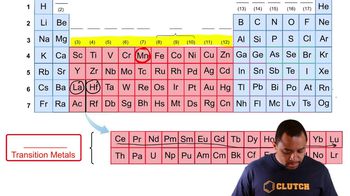
Elemental State of Metals

The elemental state of a metal refers to its natural, uncombined form, where it exists as a pure substance rather than in a compound. Metals like gold and platinum are often found in their elemental state due to their low reactivity, which prevents them from easily forming compounds. Understanding which metals can exist in this state is crucial for identifying potential sources of these metals in nature.
추천 영상:
가이드 코스
03:30
Transition Metals and Representative Elements

Reduction Processes in Metallurgy

Reduction processes in metallurgy involve the extraction of metals from their ores by removing oxygen or other elements. For example, heating zinc(II) oxide with carbon reduces the oxide to elemental zinc. This concept is essential for understanding how different metals are obtained from their ores and why some metals can be found in their elemental state while others require reduction from compounds.
추천 영상:
가이드 코스
01:10
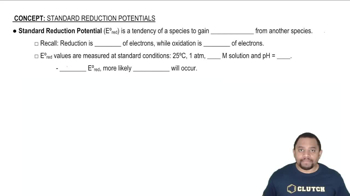
Standard Reduction Potentials
관련 실천
교과서 질문

(b) If Ksp = 1.1 * 10-12 for Ag2CrO4, what are the molar concentrations of Ag+ and CrO4 2-in solution?

520
views

교과서 질문
A sample weighing 14.98 g and containing a small amount of copper was treated to give a solution containing aque-ous Cu2+ ions. Sodium iodide was then added to yield solid copper(I) iodide plus I3 with thiosulfate, S2O3 - ion, and the I3 - was titrated 2-. The titration required 10.49 mL of 0.100 M Na2S2O3 for complete reaction. What is the mass percent copper in the sample? The balanced equations are
355
views
교과서 질문

A compound with the formula XOCl2 reacts with water, yielding HCl and another acid H2XO3, which has two acidic hydrogens that react with NaOH. When 0.350 g of XOCl2 was added to 50.0 mL of water and the resultant solution was titrated, 96.1 mL of 0.1225 M NaOH was required to react with all the acid. (b) What are the atomic mass and identity of element X?

431
views
교과서 질문

A compound with the formula XOCl2 reacts with water, yielding HCl and another acid H2XO3, which has two acidic hydrogens that react with NaOH. When 0.350 g of XOCl2 was added to 50.0 mL of water and the resultant solution was titrated, 96.1 mL of 0.1225 M NaOH was required to react with all the acid. (a) Write a balanced equation for the reaction of XOCl2 with H2O.

526
views
교과서 질문

Some metals occur naturally in their elemental state while others occur as compounds in ores. Gold, for instance, is found as the free metal; mercury is obtained by heating mercury(II) sulfide ore in oxygen; and zinc is obtained by heating zinc(II) oxide ore with coke (carbon). Judging from their positions in the activity series, which of the metals sil-ver, platinum, and chromium would probably be obtained by (c) heating its oxide with coke?

297
views
교과서 질문
A procedure for determining the amount of iron in a sample is to convert the iron to Fe2+ and then titrate it with a solu-tion of Ce(NH4)2(NO3)6: What is the mass percent of iron in a sample if 1.2284 g of the sample requires 54.91 mL of 0.1018 M Ce(NH4)2(NO3)6 for complete reaction?
650
views