Ch.4 - Reactions in Aqueous Solution
McMurry - Chemistry 8th Edition
McMurry8th EditionChemistryISBN: 9781292336145당신이 사용하는 게 아니라요?교과서 변경
4장, 문제 137c

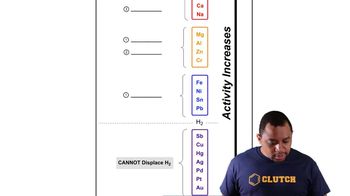
Some metals occur naturally in their elemental state while others occur as compounds in ores. Gold, for instance, is found as the free metal; mercury is obtained by heating mercury(II) sulfide ore in oxygen; and zinc is obtained by heating zinc(II) oxide ore with coke (carbon). Judging from their positions in the activity series, which of the metals sil-ver, platinum, and chromium would probably be obtained by (c) heating its oxide with coke?

검증된 단계별 안내
1
insert step 1> Identify the metals in question: silver (Ag), platinum (Pt), and chromium (Cr).
insert step 2> Recall the activity series of metals, which ranks metals by their reactivity.
insert step 3> Understand that metals lower in the activity series are less reactive and can be reduced from their oxides by heating with coke (carbon).
insert step 4> Compare the positions of silver, platinum, and chromium in the activity series to determine which is least reactive.
insert step 5> Conclude that the metal that is least reactive and can be reduced by heating its oxide with coke is the one that fits the criteria.

비슷한 문제에 대한 검증된 영상 답변:

이 영상 해법은 위 문제에 도움이 된다고 튜터들이 추천한 것입니다.
영상 길이:
1m
도움이 되었나요?

주요 개념

질문에 올바르게 답하기 위해 반드시 이해해야 하는 핵심 개념들은 다음과 같습니다.

Activity Series of Metals

The activity series is a list of metals arranged in order of decreasing reactivity. More reactive metals can displace less reactive metals from their compounds. Understanding where a metal falls in this series helps predict whether it can be extracted from its oxide using a reducing agent like coke.
추천 영상:
가이드 코스
02:02
Activity Series Chart

Reduction Reactions

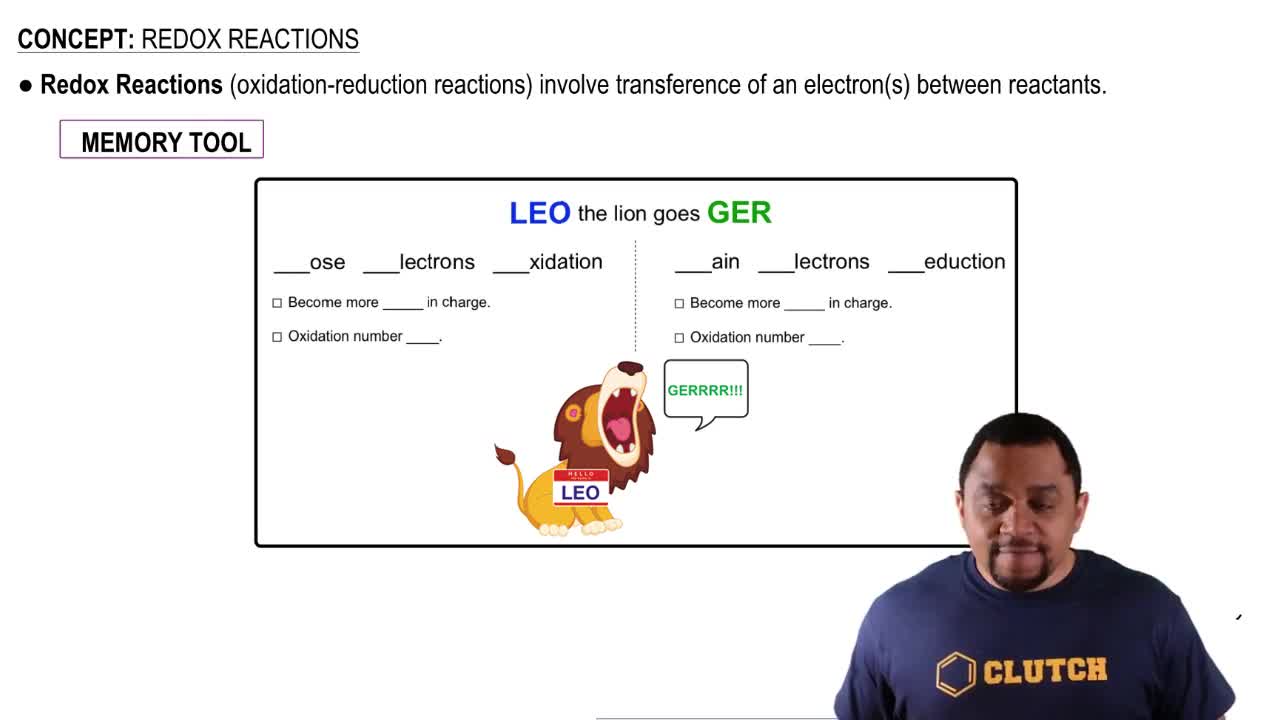
Reduction reactions involve the gain of electrons or the removal of oxygen from a substance. In metallurgy, heating an oxide with coke reduces the metal oxide to its elemental form by removing oxygen, allowing the metal to be extracted. This process is crucial for metals that are less reactive.
추천 영상:
가이드 코스
01:53
Oxidation and Reduction Reactions

Metallurgy and Ore Processing

Metallurgy is the science of extracting metals from their ores and refining them for use. Different methods, such as heating with coke or using other reducing agents, are employed based on the metal's reactivity and the nature of the ore. This knowledge is essential for determining the most efficient extraction method for specific metals.
추천 영상:
가이드 코스
04:20
Spontaneity of Processes
관련 실천
교과서 질문

(b) If Ksp = 1.1 * 10-12 for Ag2CrO4, what are the molar concentrations of Ag+ and CrO4 2-in solution?

520
views

교과서 질문
A sample weighing 14.98 g and containing a small amount of copper was treated to give a solution containing aque-ous Cu2+ ions. Sodium iodide was then added to yield solid copper(I) iodide plus I3 with thiosulfate, S2O3 - ion, and the I3 - was titrated 2-. The titration required 10.49 mL of 0.100 M Na2S2O3 for complete reaction. What is the mass percent copper in the sample? The balanced equations are
355
views
교과서 질문

A compound with the formula XOCl2 reacts with water, yielding HCl and another acid H2XO3, which has two acidic hydrogens that react with NaOH. When 0.350 g of XOCl2 was added to 50.0 mL of water and the resultant solution was titrated, 96.1 mL of 0.1225 M NaOH was required to react with all the acid. (b) What are the atomic mass and identity of element X?

431
views
교과서 질문
A 100.0 mL solution containing aqueous HCl and HBr was titrated with 0.1235 M NaOH. The volume of base required to neutralize the acid was 47.14 mL. Aqueous AgNO3 was then added to precipitate the Cl-and Br-ions as AgCl and AgBr. The mass of the silver halides obtained was 0.9974 g. What are the molarities of the HCl and HBr in the original solution?
795
views
1
comments
교과서 질문
A procedure for determining the amount of iron in a sample is to convert the iron to Fe2+ and then titrate it with a solu-tion of Ce(NH4)2(NO3)6: What is the mass percent of iron in a sample if 1.2284 g of the sample requires 54.91 mL of 0.1018 M Ce(NH4)2(NO3)6 for complete reaction?
650
views
교과서 질문

Some metals occur naturally in their elemental state while others occur as compounds in ores. Gold, for instance, is found as the free metal; mercury is obtained by heating mercury(II) sulfide ore in oxygen; and zinc is obtained by heating zinc(II) oxide ore with coke (carbon). Judging from their positions in the activity series, which of the metals sil-ver, platinum, and chromium would probably be obtained by (a) finding it in its elemental state?

1349
views