
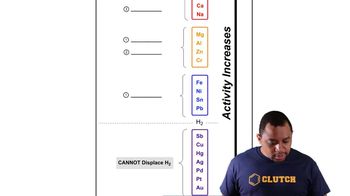
Neither strontium (Sr) nor antimony (Sb) is shown in the activity series of Table 4.5. Based on their positions in the periodic table, which would you expect to be the better reducing agent? Will the following reaction occur? Explain.
Ch.4 - Reactions in Aqueous Solution
4장, 문제 120c
Use the activity series of metals (Table 4.5) to predict the outcome of each of the following reactions. If no reaction occurs, write NR. (c)
검증된 단계별 안내1
Identify the metals and their ions involved in the reaction from the problem statement.
Refer to the activity series of metals (Table 4.5) to determine the reactivity order of the metals involved.
Compare the reactivity of the metal in its elemental form with the metal in its ionic form. A metal will only displace another metal from its compound if it is higher in the activity series.
If the elemental metal is more reactive than the metal ion it is reacting with, predict that a displacement reaction will occur. Write the balanced chemical equation for the reaction.
If the elemental metal is less reactive than the metal ion, predict that no reaction will occur and write 'NR' (No Reaction).

비슷한 문제에 대한 검증된 영상 답변:
이 영상 해법은 위 문제에 도움이 된다고 튜터들이 추천한 것입니다.
영상 길이:
2m주요 개념
질문에 올바르게 답하기 위해 반드시 이해해야 하는 핵심 개념들은 다음과 같습니다.
Activity Series of Metals
The activity series of metals is a list that ranks metals based on their reactivity, from most reactive to least reactive. It helps predict whether a metal will displace another metal in a chemical reaction. For example, a metal higher in the series can displace a metal lower in the series from its compound, while no reaction occurs if the reverse is true.
추천 영상:
가이드 코스
Activity Series Chart
Single Replacement Reactions
Single replacement reactions occur when one element replaces another in a compound. This type of reaction can be predicted using the activity series; if the free element is more reactive than the element in the compound, a reaction will occur. If not, the result is no reaction (NR).
추천 영상:
가이드 코스
Single Displacement Reactions
Predicting Reaction Outcomes
To predict the outcome of a reaction using the activity series, one must compare the reactivity of the metals involved. If the metal attempting to displace another is higher in the series, the reaction will proceed, resulting in the formation of a new compound. If it is lower, the reaction will not occur, and NR is noted.
추천 영상:
가이드 코스
Calculating Predicted Mass
관련 실천
교과서 질문
319
views
교과서 질문
Which element is oxidized and which is reduced in each of the following reactions? (b)
943
views
교과서 질문
Use the activity series of metals (Table 4.5) to predict the outcome of each of the following reactions. If no reaction occurs, write NR. (a)
426
views
교과서 질문
Use the activity series of metals (Table 4.5) to predict the outcome of each of the following reactions. If no reaction occurs, write NR. (d)
495
views
교과서 질문
Use the activity series of metals (Table 4.5) to predict the outcome of each of the following reactions. If no reaction occurs, write NR. (b)
413
views
교과서 질문
(a) Use the following reactions to arrange the elements A, B, C, and D in order of their decreasing ability as reducing agents:
313
views
