
Ch.4 - Reactions in Aqueous Solution
McMurry - Chemistry 8th Edition
McMurry8th EditionChemistryISBN: 9781292336145당신이 사용하는 게 아니라요?교과서 변경
4장, 문제 120d

Use the activity series of metals (Table 4.5) to predict the outcome of each of the following reactions. If no reaction occurs, write NR. (d)

검증된 단계별 안내
1
Identify the metals and their ions involved in the reaction from the problem statement.
Refer to the activity series of metals to determine the reactivity order of the metals involved.
Compare the reactivity of the metal in its elemental form with the metal in its ionic form. A more reactive metal will displace a less reactive metal from its compound.
If the metal in its elemental form is higher in the activity series than the metal in its ionic form, a reaction will occur resulting in the displacement of the less reactive metal.
If the metal in its elemental form is lower in the activity series than the metal in its ionic form, no reaction occurs, and you should write 'NR' (No Reaction).

비슷한 문제에 대한 검증된 영상 답변:

이 영상 해법은 위 문제에 도움이 된다고 튜터들이 추천한 것입니다.
영상 길이:
2m

주요 개념

질문에 올바르게 답하기 위해 반드시 이해해야 하는 핵심 개념들은 다음과 같습니다.

Activity Series of Metals

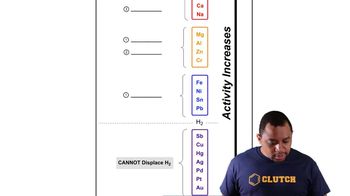
The activity series of metals is a list that ranks metals based on their reactivity, with the most reactive metals at the top and the least reactive at the bottom. This series helps predict whether a metal will displace another metal in a chemical reaction. For example, a metal higher in the series can displace a metal lower in the series from its compound, while no reaction occurs if the reverse is attempted.
추천 영상:
가이드 코스
02:02
Activity Series Chart

Single Replacement Reactions

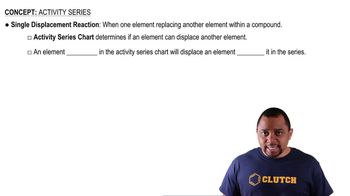
Single replacement reactions occur when one element replaces another in a compound. In the context of the activity series, this type of reaction can be predicted by comparing the reactivity of the metals involved. If the free metal is more reactive than the metal in the compound, a reaction will occur; otherwise, no reaction (NR) will take place.
추천 영상:
가이드 코스
01:11
Single Displacement Reactions

Predicting Chemical Reactions

Predicting chemical reactions involves using established rules and series, such as the activity series, to determine the outcomes of reactions. In this case, understanding the relative reactivity of metals allows chemists to foresee whether a reaction will occur or if the reactants will remain unchanged. This predictive ability is crucial for planning experiments and understanding chemical behavior.
추천 영상:
가이드 코스
03:31
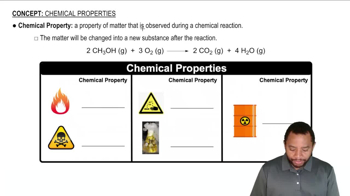
Chemical Properties