When 75.0 mL of a 0.100 M lead(II) nitrate solution is mixed with 100.0 mL of a 0.190 M potassium iodide solu-tion, a yellow-orange precipitate of lead(II) iodide is formed. What is the mass in grams of lead(II) iodide formed? Assume the reaction goes to completion. (LO 4.11, 4.15)
(a) 1.729 g
(b) 3.458 g
(c) 4.380 g
(d) 8.760 g
검증된 단계별 안내
1
First, write down the balanced chemical equation for the reaction. The reaction is between lead(II) nitrate (Pb(NO3)2) and potassium iodide (KI) to form lead(II) iodide (PbI2) and potassium nitrate (KNO3). The balanced equation is: Pb(NO3)2 + 2KI -> PbI2 + 2KNO3.
Next, calculate the number of moles of Pb(NO3)2 and KI. The number of moles is given by the formula: moles = volume (in liters) x molarity. So, for Pb(NO3)2, it's 0.075 L x 0.100 M and for KI, it's 0.100 L x 0.190 M.
From the balanced equation, we can see that the stoichiometric ratio between Pb(NO3)2 and PbI2 is 1:1. Therefore, the number of moles of PbI2 formed is equal to the number of moles of Pb(NO3)2 used, which is the limiting reagent in this reaction.
Then, calculate the mass of PbI2 formed. The molar mass of PbI2 is 461.01 g/mol. So, the mass of PbI2 formed is given by the formula: mass = moles x molar mass.
Finally, compare the calculated mass of PbI2 with the options given in the problem to find the correct answer.
비슷한 문제에 대한 검증된 영상 답변:
이 영상 해법은 위 문제에 도움이 된다고 튜터들이 추천한 것입니다.
영상 길이:
5m
영상 재생:
1 댓글
주요 개념
질문에 올바르게 답하기 위해 반드시 이해해야 하는 핵심 개념들은 다음과 같습니다.
Stoichiometry
Stoichiometry is the branch of chemistry that deals with the quantitative relationships between the reactants and products in a chemical reaction. It allows us to calculate the amounts of substances consumed and produced in a reaction based on balanced chemical equations. Understanding stoichiometry is essential for determining how much lead(II) iodide can be formed from the given solutions.
Molarity is a measure of concentration defined as the number of moles of solute per liter of solution. It is crucial for calculating the number of moles of reactants present in a solution. In this question, the molarity of lead(II) nitrate and potassium iodide solutions is used to find the moles of each reactant, which is necessary for stoichiometric calculations.
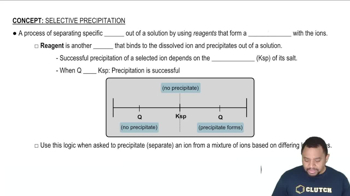
Precipitation reactions occur when two soluble salts react in solution to form an insoluble product, known as a precipitate. In this case, lead(II) iodide precipitates out of the solution when lead(II) nitrate and potassium iodide are mixed. Recognizing the formation of a precipitate is key to understanding the outcome of the reaction and calculating the mass of the product formed.


 검증된 단계별 안내

 01:16
01:16