
Ch.4 - Reactions in Aqueous Solution
McMurry - Chemistry 8th Edition
McMurry8th EditionChemistryISBN: 9781292336145당신이 사용하는 게 아니라요?교과서 변경
4장, 문제 8

Write a net ionic equation for the reaction that occurs when 10 mL of 0.5 M ammonium carbonate is mixed with 10 mL of 0.5 M silver nitrate. (LO 4.9, 4.11) (a) (b) (c) (d) A net ionic reaction cannot be written because a reaction does not take place.

검증된 단계별 안내
1
Step 1: Write the balanced molecular equation for the reaction.
Step 2: Identify the states of the reactants and products (solid, liquid, gas, aqueous).
Step 3: Write the complete ionic equation by dissociating all strong electrolytes into their ions.
Step 4: Identify and cancel out the spectator ions that appear on both sides of the complete ionic equation.
Step 5: Write the net ionic equation with the remaining species that participate in the reaction.

비슷한 문제에 대한 검증된 영상 답변:

이 영상 해법은 위 문제에 도움이 된다고 튜터들이 추천한 것입니다.
영상 길이:
5m
도움이 되었나요?

주요 개념

질문에 올바르게 답하기 위해 반드시 이해해야 하는 핵심 개념들은 다음과 같습니다.

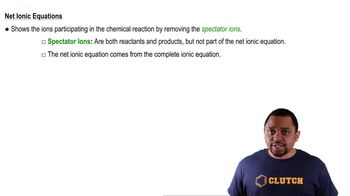
Net Ionic Equations

A net ionic equation represents the chemical species that are involved in a reaction, excluding spectator ions that do not participate in the actual chemical change. It focuses on the ions and molecules that undergo a transformation, providing a clearer picture of the reaction's essence. To write a net ionic equation, one must first identify the reactants, their states, and the products formed.
추천 영상:
가이드 코스
00:51
Net Ionic Equations

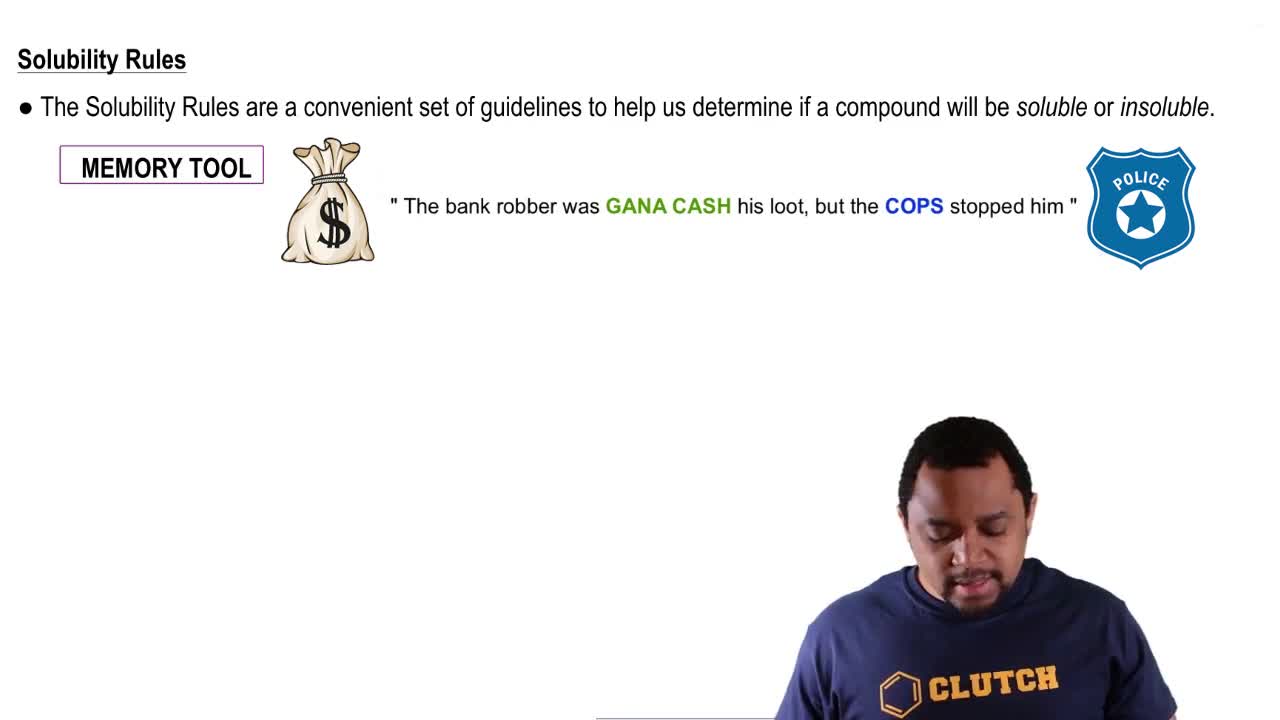
Solubility Rules

Solubility rules are guidelines that help predict whether a compound will dissolve in water. They indicate which ionic compounds are soluble or insoluble in aqueous solutions. Understanding these rules is crucial for determining if a reaction will occur when two solutions are mixed, as insoluble products may precipitate out of solution, leading to a net ionic equation.
추천 영상:
가이드 코스
00:28
Solubility Rules

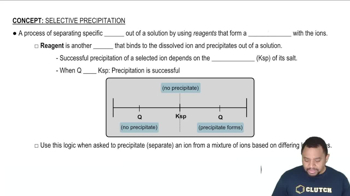
Precipitation Reactions

Precipitation reactions occur when two soluble salts react in solution to form an insoluble salt, which precipitates out of the solution. This type of reaction is common in double displacement reactions, where the cations and anions exchange partners. Recognizing whether a precipitate forms is essential for writing the net ionic equation and understanding the overall reaction process.
추천 영상:
가이드 코스
01:53
Selective Precipitation
관련 실천
교과서 질문
When 75.0 mL of a 0.100 M lead(II) nitrate solution is mixed with 100.0 mL of a 0.190 M potassium iodide solu-tion, a yellow-orange precipitate of lead(II) iodide is formed. What is the mass in grams of lead(II) iodide formed? Assume the reaction goes to completion. (LO 4.11, 4.15) (a) 1.729 g (b) 3.458 g (c) 4.380 g (d) 8.760 g
1393
views
1
comments
교과서 질문
Which of the following solutions will not form a precipitate when added to 10 mL of 0.10 M KOH? (LO 4.10, 4.11) (a) 10 mL of 0.10 NH4Cl (b) 10 mL of 0.10 M PbSO4 (c) 10 mL of 0.10 M Fe(NO3)3 (d) 10 mL of 0.10 M AgCH3CO2
787
views
교과서 질문
Refer to the figure to answer questions 4 and 5. The images are a molecular representation of three different substances, AX3, AY3, and AZ3, dissolved in water. (Water molecules are omitted for clarity.) What are the molar concentrations of A ions and X ions in a 0.500 M solution of AX3? (LO 4.7) (a) 0.500 M A and 0.500 M X (b) 0.500 M A and 0.167 M X (c) 1.500 M A and 0.500 M X (d) 0.500 M A and 1.500 M X
306
views
교과서 질문
Succinic acid, an intermediate in the metabolism of food molecules, has a molecular weight of 118.1. When 1.926 g of succinic acid was dissolved in water and titrated, 65.20 mL of 0.5000 M NaOH solution was required to neutralize the acid. How many acidic hydrogens are there in a mol-ecule of succinic acid? (LO 4.16) (a) 1 (b) 2 (c) 3 (d) 4
1095
views
교과서 질문
Which of the following substances will produce a solution that does not conduct electricity when it dissolves in water? (LO 4.6) (a) NaOH (b) HNO3 (c) Na2SO4 (d) CH3OH
1066
views
교과서 질문
What volume of 0.250 M HCl is needed to react completely with 25.00 mL of 0.375 M Na2CO3? (LO 4.15) (a) 75.0 mL (b) 18.8 mL (c) 37.5 mL (d) 33.3 mL
1023
views