Protons and electrons can be given very high energies in particle accelerators. What is the wavelength in meters of an electron (mass = 9.11 * 10-31 kg) that has been accelerated to 5% of the speed of light? In what region of the electromagnetic spectrum is this wavelength?
검증된 단계별 안내
1
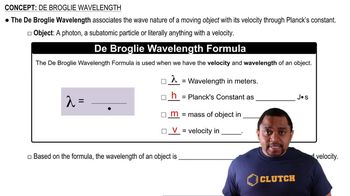
First, we need to use the de Broglie wavelength equation, which is λ = h / (m*v), where λ is the wavelength, h is Planck's constant (6.626 * 10^-34 Js), m is the mass of the electron, and v is the velocity of the electron.
Next, we need to calculate the velocity of the electron. Given that the electron has been accelerated to 5% of the speed of light, we multiply the speed of light (3.00 * 10^8 m/s) by 0.05 to get the velocity.
Substitute the values of Planck's constant, the mass of the electron, and the calculated velocity into the de Broglie wavelength equation to find the wavelength.
The wavelength obtained will be in meters. To convert it to a more manageable unit, you might want to convert it to nanometers by multiplying the result by 10^9.
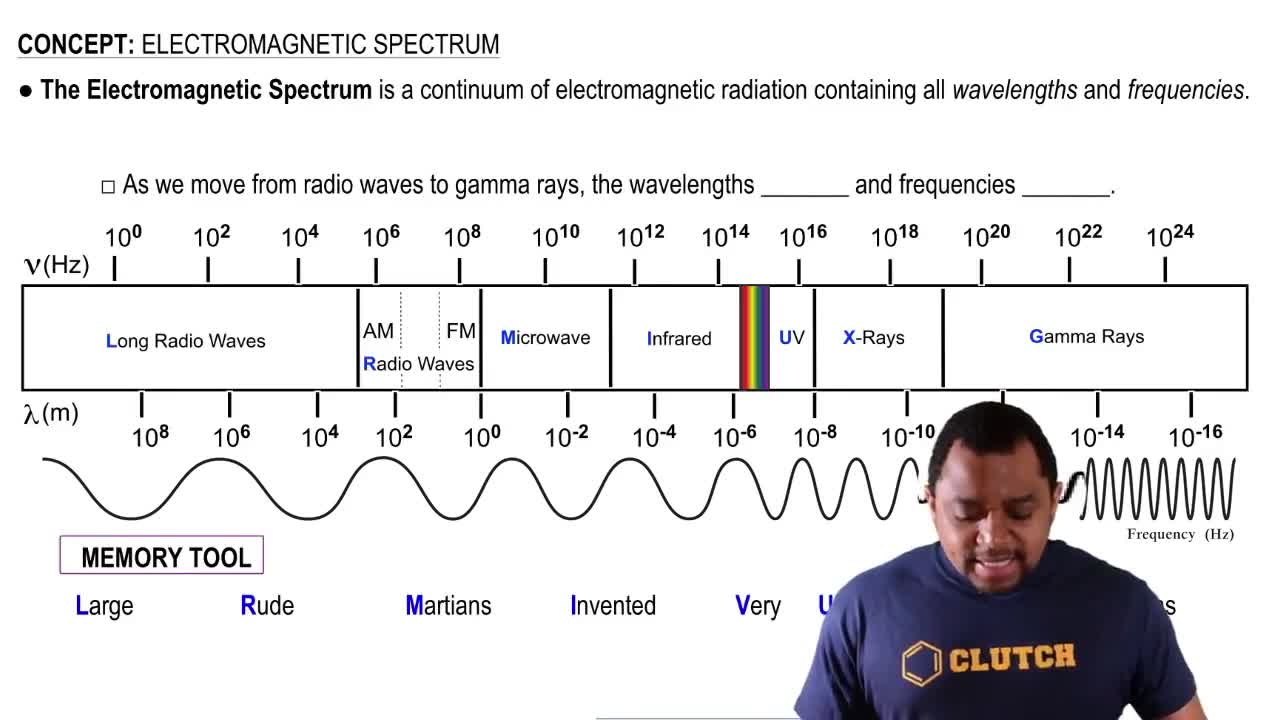
Finally, compare the calculated wavelength with the ranges of wavelengths for different regions of the electromagnetic spectrum to determine in which region this wavelength falls. The electromagnetic spectrum ranges from radio waves (longest wavelength) to gamma rays (shortest wavelength).
비슷한 문제에 대한 검증된 영상 답변:
이 영상 해법은 위 문제에 도움이 된다고 튜터들이 추천한 것입니다.
영상 길이:
1m
영상 재생:
0 댓글
도움이 되었나요?
주요 개념
질문에 올바르게 답하기 위해 반드시 이해해야 하는 핵심 개념들은 다음과 같습니다.
De Broglie Wavelength
The De Broglie wavelength is a concept that describes the wave-like behavior of particles, such as electrons. It is given by the formula λ = h/p, where λ is the wavelength, h is Planck's constant, and p is the momentum of the particle. For an electron, its momentum can be calculated using its mass and velocity, allowing us to determine its wavelength when it is accelerated.
When particles like electrons are accelerated to significant fractions of the speed of light, relativistic effects become important. These effects, described by Einstein's theory of relativity, indicate that the mass of the particle effectively increases with speed, affecting its momentum and energy. For speeds approaching the speed of light, the classical equations of motion must be modified to account for these relativistic changes.
The electromagnetic spectrum encompasses all types of electromagnetic radiation, ranging from radio waves to gamma rays. Each type of radiation is characterized by its wavelength and frequency. Understanding where a calculated wavelength falls within this spectrum helps identify its properties and potential applications, such as whether it is in the visible light range or in the X-ray region.