What is the expected ground-state electron configuration of the recently discovered element with Z = 116?
검증된 단계별 안내
1
Identify the atomic number (Z) of the element, which is given as 116. This number tells us there are 116 protons in the nucleus and, in a neutral atom, 116 electrons.
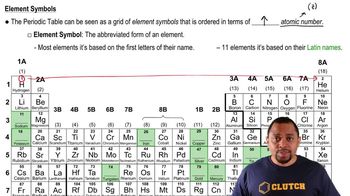
Refer to the periodic table and locate the position of the element. Element 116 falls into the p-block of the 7th period, specifically in group 16, which is the oxygen family or chalcogens.
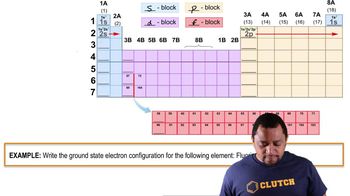
Start filling the electron orbitals in the order of increasing energy levels. Begin with the 1s orbital and continue filling the s, p, d, and f orbitals according to the Aufbau principle until all 116 electrons are accounted for.
Apply the Pauli Exclusion Principle and Hund's Rule while filling each orbital. The Pauli Exclusion Principle states that no two electrons in an atom can have the same set of four quantum numbers, and Hund's Rule states that electrons must occupy every orbital singly before any orbital is doubly occupied.
The expected ground-state electron configuration for element 116 will be: [Rn] 5f14 6d10 7s2 7p4. This configuration shows the electrons are filled up to the radon (Rn) core, followed by the filling of the 5f, 6d, 7s, and 7p orbitals.
비슷한 문제에 대한 검증된 영상 답변:
이 영상 해법은 위 문제에 도움이 된다고 튜터들이 추천한 것입니다.
영상 길이:
3m
영상 재생:
0 댓글
주요 개념
질문에 올바르게 답하기 위해 반드시 이해해야 하는 핵심 개념들은 다음과 같습니다.
Electron Configuration
Electron configuration describes the distribution of electrons in an atom's orbitals. It follows the Aufbau principle, which states that electrons fill orbitals starting from the lowest energy level to the highest. The configuration is typically represented using the notation of subshells (s, p, d, f) and the number of electrons in each subshell.
The periodic table organizes elements based on their atomic number, which is the number of protons in the nucleus. Each element has a unique atomic number, and for element Z = 116, this indicates it is the 116th element, known as livermorium. The position of an element in the periodic table helps predict its electron configuration based on its group and period.
Valence electrons are the outermost electrons of an atom and are crucial for determining chemical reactivity and bonding. The electron configuration reveals how many valence electrons an element has, which is influenced by its position in the periodic table. For heavy elements like Z = 116, understanding the filling of d and f orbitals is essential for predicting their chemical behavior.


 검증된 단계별 안내
 01:33
01:33