Why do atomic radii decrease from left to right across a period of the periodic table?
검증된 단계별 안내
1
Atomic radii refer to the size of an atom, typically measured from the nucleus to the outermost electron shell.
As you move from left to right across a period in the periodic table, the number of protons in the nucleus increases.
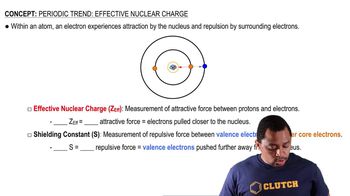
This increase in protons results in a greater positive charge in the nucleus, which attracts the negatively charged electrons more strongly.
The increased nuclear charge pulls the electron cloud closer to the nucleus, reducing the size of the atom.
Therefore, the atomic radii decrease from left to right across a period due to the increased effective nuclear charge.
비슷한 문제에 대한 검증된 영상 답변:
이 영상 해법은 위 문제에 도움이 된다고 튜터들이 추천한 것입니다.
영상 길이:
2m
영상 재생:
0 댓글
주요 개념
질문에 올바르게 답하기 위해 반드시 이해해야 하는 핵심 개념들은 다음과 같습니다.
Atomic Radius
Atomic radius refers to the distance from the nucleus of an atom to the outermost shell of electrons. It is a measure of the size of an atom and can vary based on the atom's position in the periodic table.
Effective nuclear charge is the net positive charge experienced by an electron in a multi-electron atom. As you move from left to right across a period, the number of protons increases, leading to a higher effective nuclear charge, which pulls electrons closer to the nucleus.
Electron shielding occurs when inner-shell electrons partially block the attraction between the nucleus and the outer-shell electrons. As you move across a period, the increase in protons is not significantly countered by shielding, resulting in a stronger attraction and a decrease in atomic radius.


 검증된 단계별 안내

 02:02
02:02