

Ch.6 - Ionic Compounds: Periodic Trends and Bonding Theory
McMurry - Chemistry 8th Edition
McMurry8th EditionChemistryISBN: 9781292336145당신이 사용하는 게 아니라요?교과서 변경
6장, 문제 4

Arrange the ions Rb+, Br-, and Sr2+ from the smallest to the largest. (LO 6.4) (a) Br- < Rb+ < Sr2+ (b) Sr2+ < Br- < Rb+ (c) Rb+ < Sr2+ < Br- (d) Sr2+ < Rb+ < Br-

검증된 단계별 안내
1
Step 1: Understand that ionic size is influenced by the number of electrons and the effective nuclear charge. Cations (positive ions) are generally smaller than their parent atoms, while anions (negative ions) are larger.
Step 2: Consider the electron configuration of each ion. Rb⁺ has lost one electron compared to its neutral atom, Br⁻ has gained one electron, and Sr²⁺ has lost two electrons.
Step 3: Recognize that losing electrons (as in Rb⁺ and Sr²⁺) results in a smaller ionic radius due to increased effective nuclear charge, while gaining electrons (as in Br⁻) results in a larger ionic radius.
Step 4: Compare the effective nuclear charge and electron configuration: Sr²⁺, having lost two electrons, will be smaller than Rb⁺, which has lost one electron. Br⁻, having gained an electron, will be larger than both.
Step 5: Arrange the ions based on the analysis: Sr²⁺ < Rb⁺ < Br⁻. This corresponds to option (d) in the given choices.

주요 개념

질문에 올바르게 답하기 위해 반드시 이해해야 하는 핵심 개념들은 다음과 같습니다.

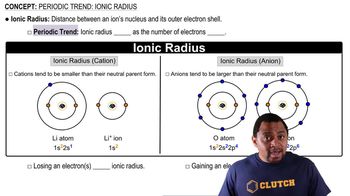
Ionic Radius

Ionic radius refers to the size of an ion in a crystal lattice. Cations (positively charged ions) are generally smaller than their neutral atoms due to the loss of electrons, which reduces electron-electron repulsion. Conversely, anions (negatively charged ions) are larger than their neutral atoms because the addition of electrons increases repulsion among them. Understanding ionic radius is crucial for comparing the sizes of different ions.
추천 영상:

Charge and Size Relationship

The charge of an ion significantly influences its size. Cations with higher positive charges, such as Sr<sup>2+</sup>, are smaller than those with lower positive charges, like Rb<sup>+</sup>, because the increased nuclear charge pulls the remaining electrons closer to the nucleus. In contrast, anions like Br<sup>-</sup> are larger than cations due to the added electron, which increases electron-electron repulsion, leading to a larger ionic size.
추천 영상:

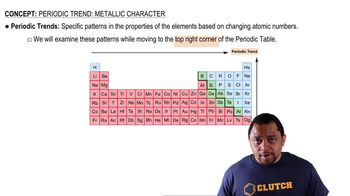
Trends in the Periodic Table

Trends in the periodic table, such as atomic size and ionic size, help predict the relative sizes of ions. Generally, ionic size decreases across a period from left to right due to increasing nuclear charge and increases down a group due to the addition of electron shells. Recognizing these trends allows for a systematic approach to comparing the sizes of ions like Rb<sup>+</sup>, Br<sup>-</sup>, and Sr<sup>2+</sup>.
추천 영상:
가이드 코스
00:38
Periodic Trends