Ch.6 - Ionic Compounds: Periodic Trends and Bonding Theory
McMurry - Chemistry 8th Edition
McMurry8th EditionChemistryISBN: 9781292336145당신이 사용하는 게 아니라요?교과서 변경
6장, 문제 103a

Consider the electronic structure of the element bismuth. (a) The first ionization energy of bismuth is Ei1 = +703 kJ/ mol. What is the longest possible wavelength of light that could ionize an atom of bismuth?

검증된 단계별 안내
1
Identify the relationship between energy and wavelength using the equation: \( E = \frac{hc}{\lambda} \), where \( E \) is the energy, \( h \) is Planck's constant (6.626 \(\times\) 10^{-34} \(\text{ J s}\)), \( c \) is the speed of light (3.00 \(\times\) 10^8 \(\text{ m/s}\)), and \( \lambda \) is the wavelength.
Convert the ionization energy from kJ/mol to J/atom. Since 1 mol contains Avogadro's number of atoms (6.022 \(\times\) 10^{23} \(\text{ atoms/mol}\)), use the conversion: \( 703 \text{ kJ/mol} \times \frac{1000 \text{ J}}{1 \text{ kJ}} \times \frac{1 \text{ mol}}{6.022 \times 10^{23} \text{ atoms}} \).
Substitute the converted energy value into the equation \( E = \frac{hc}{\lambda} \) to solve for \( \lambda \).
Rearrange the equation to solve for wavelength: \( \lambda = \frac{hc}{E} \).
Calculate the wavelength using the values for \( h \), \( c \), and the converted \( E \) to find the longest possible wavelength of light that could ionize an atom of bismuth.

비슷한 문제에 대한 검증된 영상 답변:

이 영상 해법은 위 문제에 도움이 된다고 튜터들이 추천한 것입니다.
영상 길이:
3m
도움이 되었나요?

주요 개념

질문에 올바르게 답하기 위해 반드시 이해해야 하는 핵심 개념들은 다음과 같습니다.

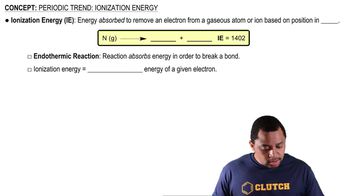
Ionization Energy

Ionization energy is the amount of energy required to remove an electron from an atom in its gaseous state. For bismuth, the first ionization energy is 703 kJ/mol, indicating the energy needed to remove the outermost electron. This concept is crucial for understanding how much energy is necessary to ionize an atom and relates directly to the wavelength of light that can provide this energy.
추천 영상:
가이드 코스
01:19
Ionization Energy

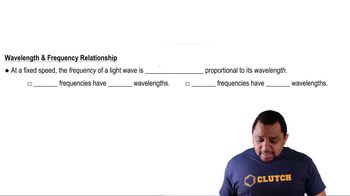
Photon Energy and Wavelength Relationship

The energy of a photon is inversely related to its wavelength, described by the equation E = hc/λ, where E is energy, h is Planck's constant, c is the speed of light, and λ is the wavelength. This relationship means that longer wavelengths correspond to lower energy photons. To find the longest wavelength capable of ionizing bismuth, one must calculate the wavelength that corresponds to the ionization energy.
추천 영상:
가이드 코스
00:31
Frequency-Wavelength Relationship

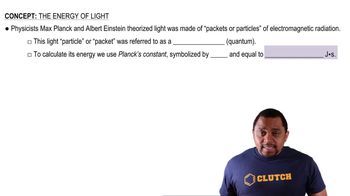
Planck's Constant

Planck's constant (h) is a fundamental constant in quantum mechanics, valued at approximately 6.626 x 10^-34 J·s. It relates the energy of a photon to its frequency and wavelength. Understanding this constant is essential for calculating the energy of photons and determining the wavelength of light needed to achieve specific energy transitions, such as ionization.
추천 영상:
가이드 코스
00:50
Photons and Planck's Constant