Ch.6 - Ionic Compounds: Periodic Trends and Bonding Theory
McMurry - Chemistry 8th Edition
McMurry8th EditionChemistryISBN: 9781292336145당신이 사용하는 게 아니라요?교과서 변경
6장, 문제 10

Predict the formula of the ionic compound that forms between potassium and sulfur. (LO 6.11) (a) KS (b) KS2 (c) K2S2 (d) K2S

검증된 단계별 안내
1
Identify the charges of the ions formed by potassium and sulfur. Potassium (K) typically forms a +1 cation (K+), and sulfur (S) typically forms a -2 anion (S2-).
Use the crisscross method to balance the charges of the ions. The absolute value of the charge of each ion becomes the subscript of the other ion.
Write the formula by placing the cation first and the anion second, ensuring that the subscripts are in the lowest whole number ratio and are written as simple integers.
Check if the total charges from the cations and anions balance to zero, confirming the compound is electrically neutral.
The resulting formula should reflect a balance where the total positive charge from potassium equals the total negative charge from sulfur.

비슷한 문제에 대한 검증된 영상 답변:

이 영상 해법은 위 문제에 도움이 된다고 튜터들이 추천한 것입니다.
영상 길이:
49s
도움이 되었나요?

주요 개념

질문에 올바르게 답하기 위해 반드시 이해해야 하는 핵심 개념들은 다음과 같습니다.

Ionic Compounds

Ionic compounds are formed when atoms transfer electrons, resulting in the formation of positively charged cations and negatively charged anions. The electrostatic attraction between these oppositely charged ions leads to the creation of a stable compound. Understanding the charges of the involved ions is crucial for predicting the correct formula of the ionic compound.
추천 영상:
가이드 코스
02:11
Ionic Compounds Naming

Valency and Charge of Ions

The valency of an element indicates its ability to combine with other elements, often determined by the number of electrons in its outer shell. Potassium (K) has a valency of +1, while sulfur (S) has a valency of -2. This difference in valency is essential for determining the ratio of ions in the resulting ionic compound.
추천 영상:
가이드 코스
01:39
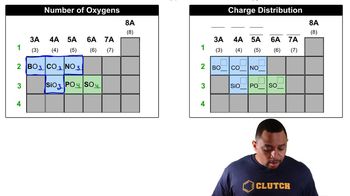
Polyatomic Ion Charges

Chemical Formula Representation

The chemical formula of an ionic compound reflects the ratio of the constituent ions. For potassium and sulfur, the correct formula must balance the total positive and negative charges. This involves using subscripts to indicate the number of each type of ion, ensuring that the overall charge of the compound is neutral.
추천 영상:
가이드 코스
02:08
Molecular Formula
관련 실천
교과서 질문

Which molecular scale image best represents the ionic com-pound that forms between cesium and chlorine? (Cesium is represented by red circles, and chlorine is represented by blue circles.) (LO 6.12) (a)

(b)

(c)

(d)

273
views

교과서 질문
Which of the following processes will release the most energy? (LO 6.9) (a) (b) (c) (d)
336
views
교과서 질문

Given the following information, construct a Born–Haber cycle to calculate the lattice energy of CaCl2(s). (LO 6.13)

Net energy change for the formation of CaCl2(s) form Ca(s) and Cl2(g) = -795.4 kJ/mol

Heat of sublimation for Ca(s) = +178 kJ/mol

Ei1 for Ca(s) = +590 kJ/mol

Ei2 for Ca(g) = +1145 kJ/mol

Bond dissociation energy for Cl2(g) = +243 kJ/mol

Eea1 for Cl(g) = -348.6 kJ/mol

(a) 2603 kJ/mol (b) 2254 kJ/mol (c) 2481 kJ/mo (d) 1663 kJ/mol

708
views
교과서 질문
Elements that have large negative electron affinities generally have (LO 6.10) (a) high values for Zeff and a vacancy in a valence orbital. (b) low values for Zeff and a vacancy in a valence orbital. (c) high values for Zeff and filled valence orbitals. (d) low values for Zeff and filled valence orbitals.
443
views
교과서 질문
For a multielectron atom, a 3s orbital lies lower in energy than a 3p orbital because (LO 5.16) (a) a 3p orbital has more nodal surfaces than a 3s orbital. (b) an electron in a 3p orbital has a higher probability of being closer to the nucleus than an electron in a 3s orbital. (c) inner electrons shield electrons in a 3p orbital more effec-tively than electrons in a 3s orbital. (d) the energy of the electron can be spread between three 3p orbitals instead of only one 3s orbital.
1786
views
교과서 질문
The successive ionization energies for a second-period element are given. What is the identity of the element? (LO 6.8) Ea1 = 1402 kJ/mol Ea2 = 2856 kJ/mol Ea3 = 4578 kJ/mol Ea4 = 7475 kJ/mol Ea5 = 9445 kJ/mol Ea6 = 53,266 kJ/mol Ea7 = 64,630 kJ/mol (a) Be (b) C (c) N (d) F
666
views