Three atoms have the following electron configurations: (a) 1s2 2s2 2p6 3s2 3p1 (b) 1s2 2s2 2p6 3s2 3p5 (c) 1s2 2s2 2p6 3s2 3p6 4s1. Which of the three has the largest Ei1? Which has the smallest Ei4?
검증된 단계별 안내
1
Step 1: Identify the elements based on their electron configurations. For (a) 1s^2 2s^2 2p^6 3s^2 3p^1, the element is Aluminum (Al). For (b) 1s^2 2s^2 2p^6 3s^2 3p^5, the element is Chlorine (Cl). For (c) 1s^2 2s^2 2p^6 3s^2 3p^6 4s^1, the element is Potassium (K).
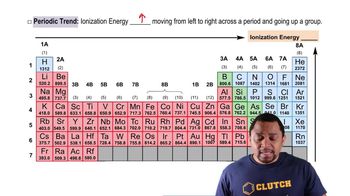
Step 2: Understand the concept of first ionization energy (Ei1), which is the energy required to remove the outermost electron from a neutral atom in the gaseous state. Generally, ionization energy increases across a period and decreases down a group in the periodic table.
Step 3: Compare the first ionization energies (Ei1) of the identified elements. Chlorine (Cl) is located further to the right in the periodic table compared to Aluminum (Al) and Potassium (K), indicating it has the highest Ei1 due to increased nuclear charge and smaller atomic radius.
Step 4: Understand the concept of fourth ionization energy (Ei4), which is the energy required to remove the fourth electron after the first three have been removed. This is generally higher for elements with a stable electron configuration after the third ionization.
Step 5: Compare the fourth ionization energies (Ei4) of the identified elements. Potassium (K) has a single electron in the 4s orbital, and after the first electron is removed, it achieves a noble gas configuration, making subsequent ionizations more difficult. Therefore, Potassium (K) is likely to have the smallest Ei4.
주요 개념
질문에 올바르게 답하기 위해 반드시 이해해야 하는 핵심 개념들은 다음과 같습니다.
Ionization Energy (Ei)
Ionization energy (Ei) is the energy required to remove an electron from an atom in its gaseous state. The first ionization energy (Ei1) refers to the energy needed to remove the outermost electron, while the fourth ionization energy (Ei4) involves removing the fourth electron. Generally, ionization energy increases across a period due to increased nuclear charge and decreases down a group due to increased distance from the nucleus and electron shielding.
Electron configuration describes the distribution of electrons in an atom's orbitals. It provides insight into an atom's chemical properties and reactivity. The configurations given in the question indicate the number of electrons in each energy level and sublevel, which directly influences the atom's ionization energies. Understanding these configurations helps predict which atom will have higher or lower ionization energies based on their electron arrangements.
Ionization energy exhibits specific trends in the periodic table: it generally increases from left to right across a period and decreases from top to bottom within a group. This trend is due to factors such as effective nuclear charge and electron shielding. Atoms with more protons in the nucleus (higher atomic number) tend to have higher ionization energies, as they hold their electrons more tightly, making it harder to remove them.


 검증된 단계별 안내
 01:19
01:19