The first four ionization energies in kJ/mol of a certain second-row element are 801, 2427, 3660, and 25,025. What is the likely identity of the element?
검증된 단계별 안내
1
Step 1: Understand the concept of ionization energy, which is the energy required to remove an electron from an atom in the gaseous state. The first ionization energy is for removing the first electron, the second for the second electron, and so on.
Step 2: Note the significant jump in ionization energy between the third (3660 kJ/mol) and fourth (25,025 kJ/mol) values. This indicates that the fourth electron is being removed from a stable, filled shell, suggesting a noble gas configuration.
Step 3: Recognize that the element is in the second row of the periodic table, which includes elements from Lithium (Li) to Neon (Ne).
Step 4: Consider the electronic configurations of second-row elements. The large jump in ionization energy suggests the removal of an electron from a noble gas configuration, which is likely after the removal of three electrons from an element with a configuration ending in 2p^6.
Step 5: Identify the element with three valence electrons in the second row, which is Boron (B). After removing three electrons, Boron achieves the stable configuration of Helium (He), explaining the large increase in ionization energy for the fourth electron.
주요 개념
질문에 올바르게 답하기 위해 반드시 이해해야 하는 핵심 개념들은 다음과 같습니다.
Ionization Energy
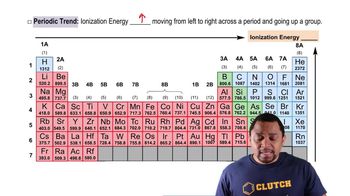
Ionization energy is the energy required to remove an electron from a gaseous atom or ion. It is a key indicator of an element's reactivity and can vary significantly among elements. Generally, the first ionization energy is lower than subsequent ionization energies due to increased positive charge in the nucleus as electrons are removed, making it harder to remove additional electrons.
Ionization energy trends can be observed across periods and groups in the periodic table. As you move from left to right across a period, ionization energy typically increases due to greater nuclear charge attracting electrons more strongly. Conversely, as you move down a group, ionization energy decreases because of increased electron shielding and distance from the nucleus, making it easier to remove outer electrons.
Element Identification through Ionization Energies
The pattern of ionization energies can help identify elements. A significant jump in ionization energy, such as the large increase from the fourth to the fifth ionization energy, suggests that the element has a stable electron configuration after the removal of a certain number of electrons. In this case, the large jump indicates that the element likely has four valence electrons, suggesting it is a group 14 element, such as carbon or silicon.


 검증된 단계별 안내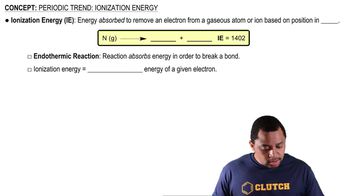
 01:19
01:19