Ch.6 - Ionic Compounds: Periodic Trends and Bonding Theory
McMurry - Chemistry 8th Edition
McMurry8th EditionChemistryISBN: 9781292336145당신이 사용하는 게 아니라요?교과서 변경
6장, 문제 69

Which has the more negative electron affinity, Br or Br⁻?

검증된 단계별 안내
1
Step 1: Understand the concept of electron affinity. Electron affinity is the energy change that occurs when an electron is added to a neutral atom in the gaseous state to form a negative ion.
Step 2: Consider the electron affinity of a neutral bromine atom (Br). When a neutral bromine atom gains an electron, it becomes a bromide ion (Br⁻), and this process releases energy, indicating a negative electron affinity.
Step 3: Analyze the electron affinity of the bromide ion (Br⁻). Adding an electron to an already negatively charged ion (Br⁻) is less favorable because of electron-electron repulsion, and it requires energy input, resulting in a positive or less negative electron affinity.
Step 4: Compare the two scenarios. The neutral bromine atom (Br) has a more negative electron affinity because it releases energy when gaining an electron, whereas the bromide ion (Br⁻) would require energy to gain an additional electron.
Step 5: Conclude that the neutral bromine atom (Br) has a more negative electron affinity compared to the bromide ion (Br⁻) due to the energy release when forming Br⁻ from Br.

주요 개념

질문에 올바르게 답하기 위해 반드시 이해해야 하는 핵심 개념들은 다음과 같습니다.

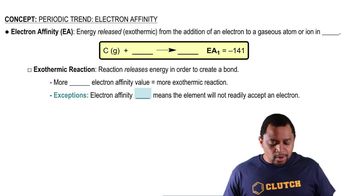
Electron Affinity

Electron affinity is the amount of energy released when an electron is added to a neutral atom in the gas phase, forming a negative ion. A more negative electron affinity indicates a greater tendency for an atom to gain an electron, which is often associated with the stability of the resulting anion.
추천 영상:
가이드 코스
01:34
Electron Affinity

Comparison of Atoms and Ions

When comparing the electron affinity of a neutral atom like bromine (Br) to that of its anion (Br⁻), it is essential to consider the electronic structure. The addition of an electron to Br results in Br⁻, which already has an extra electron, affecting its ability to attract another electron due to increased electron-electron repulsion.
추천 영상:
가이드 코스
2:38
Atomic Mass Comparison Example

Trends in the Periodic Table

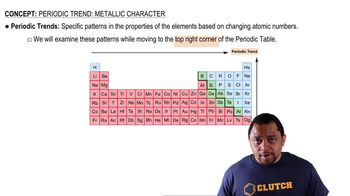
Electron affinity generally increases (becomes more negative) across a period from left to right and decreases down a group in the periodic table. Understanding these trends helps predict the behavior of elements like bromine, as its position in the periodic table influences its electron affinity compared to its anion.
추천 영상:
가이드 코스
00:38
Periodic Trends