Ch.6 - Ionic Compounds: Periodic Trends and Bonding Theory
McMurry - Chemistry 8th Edition
McMurry8th EditionChemistryISBN: 9781292336145당신이 사용하는 게 아니라요?교과서 변경
6장, 문제 71

Why does ionization energy increase regularly across the periodic table from group 1A to group 8A, whereas electron affinity increases irregularly from group 1A to group 7A and then falls dramatically for group 8A?

검증된 단계별 안내
1
1. Ionization energy is the energy required to remove an electron from an atom. As we move from left to right across a period (from group 1A to group 8A), the number of protons in the nucleus increases. This increases the positive charge of the nucleus, which in turn increases the force of attraction between the nucleus and the electrons. This makes it harder to remove an electron, hence the ionization energy increases.
2. At the same time, the electrons are being added to the same energy level, so the increase in electron-electron repulsion is minimal. This means that the increase in nuclear charge has a greater effect, leading to an increase in ionization energy.
3. Electron affinity is the energy change when an electron is added to an atom. It generally increases from left to right across a period (from group 1A to group 7A) due to the increasing nuclear charge, which attracts the added electron more strongly.
4. However, there are exceptions to this trend. For example, electron affinity does not increase from group 2A to group 3A because the added electron in group 3A elements goes into a higher energy p-orbital, rather than the lower energy s-orbital. Similarly, electron affinity does not increase from group 5A to group 6A because the added electron in group 6A elements must pair up with an existing electron in a p-orbital, which is energetically unfavorable due to electron-electron repulsion.
5. Electron affinity falls dramatically for group 8A elements because their outermost energy level is full, so any added electron would have to go into a significantly higher energy level. This is energetically unfavorable, so these elements have low electron affinities.

비슷한 문제에 대한 검증된 영상 답변:

이 영상 해법은 위 문제에 도움이 된다고 튜터들이 추천한 것입니다.
영상 길이:
2m
도움이 되었나요?

주요 개념

질문에 올바르게 답하기 위해 반드시 이해해야 하는 핵심 개념들은 다음과 같습니다.

Ionization Energy

Ionization energy is the energy required to remove an electron from an atom in its gaseous state. It generally increases across a period from left to right due to increasing nuclear charge, which attracts electrons more strongly, making them harder to remove. Additionally, as atomic size decreases, the outer electrons are held more tightly, contributing to the trend.
추천 영상:
가이드 코스
01:19
Ionization Energy

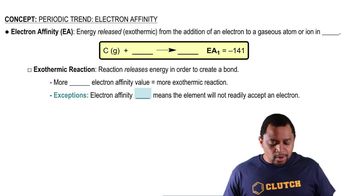
Electron Affinity

Electron affinity refers to the energy change that occurs when an electron is added to a neutral atom in the gas phase. This property does not follow a simple trend across the periodic table; while it generally becomes more negative (indicating a greater tendency to gain electrons) from group 1A to group 7A, the dramatic drop in group 8A occurs because noble gases have a complete valence shell and do not favorably accept additional electrons.
추천 영상:
가이드 코스
01:34
Electron Affinity

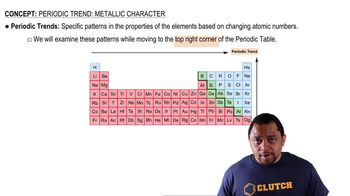
Periodic Trends

Periodic trends are patterns observed in the properties of elements across the periodic table, influenced by atomic structure. These trends include ionization energy, electron affinity, atomic radius, and electronegativity. Understanding these trends helps explain why certain properties change in a predictable manner across periods and groups, reflecting the underlying principles of atomic interactions and electron configurations.
추천 영상:
가이드 코스
00:38
Periodic Trends