Ch.7 - Covalent Bonding and Electron-Dot Structures
McMurry - Chemistry 8th Edition
McMurry8th EditionChemistryISBN: 9781292336145당신이 사용하는 게 아니라요?교과서 변경
7장, 문제 56

Order the following compounds according to the increasing ionic character of their bonds: CCl4, BaCl2, TiCl3, ClO2.

검증된 단계별 안내
1
Step 1: Understand the concept of ionic character. Ionic character refers to the degree to which a bond between two atoms has characteristics of an ionic bond, which typically involves the transfer of electrons from one atom to another.
Step 2: Identify the types of bonds in each compound. CCl4 and ClO2 have covalent bonds, while BaCl2 and TiCl3 have ionic bonds.
Step 3: Consider the electronegativity difference between the atoms in each compound. A larger difference in electronegativity usually indicates a greater ionic character.
Step 4: Compare the electronegativity differences. BaCl2, with a metal and a non-metal, is expected to have the highest ionic character. TiCl3, also a metal and non-metal compound, follows. CCl4 and ClO2, being covalent, have lower ionic character.
Step 5: Order the compounds from least to most ionic character: ClO2, CCl4, TiCl3, BaCl2.

비슷한 문제에 대한 검증된 영상 답변:

이 영상 해법은 위 문제에 도움이 된다고 튜터들이 추천한 것입니다.
영상 길이:
4m
도움이 되었나요?

주요 개념

질문에 올바르게 답하기 위해 반드시 이해해야 하는 핵심 개념들은 다음과 같습니다.

Ionic Character

Ionic character refers to the degree to which a bond between two atoms exhibits ionic properties, which is influenced by the difference in electronegativity between the bonded atoms. A higher electronegativity difference typically results in a more ionic bond, while a smaller difference leads to a more covalent bond. Understanding this concept is crucial for comparing the ionic character of different compounds.
추천 영상:
가이드 코스
00:56
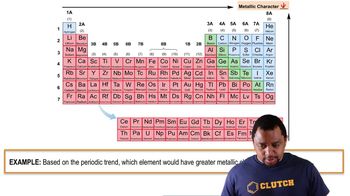
Metallic Character Example

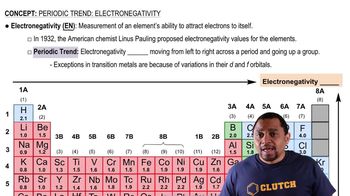
Electronegativity

Electronegativity is a measure of an atom's ability to attract and hold onto electrons in a chemical bond. The Pauling scale is commonly used to quantify electronegativity values, with fluorine being the most electronegative element. By comparing the electronegativity values of the elements in the given compounds, one can assess the ionic character of their bonds.
추천 영상:
가이드 코스
02:10
Electronegativity Trends

Bond Type Classification

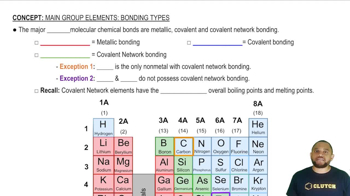
Compounds can be classified based on the types of bonds they contain: ionic, covalent, or polar covalent. Ionic compounds typically form between metals and nonmetals, while covalent compounds form between nonmetals. Recognizing the nature of the bonds in each compound listed in the question is essential for ordering them by increasing ionic character.
추천 영상: