Which of the substances CdBr2, P4, BrF3, MgO, NF3, BaCl2, POCl3, and LiBr contain bonds that are:
(b) nonpolar covalent?
검증된 단계별 안내
1
Identify the type of elements involved in each compound. Nonpolar covalent bonds typically occur between nonmetals with similar electronegativities.
Examine each compound to determine if it consists of nonmetals only. Nonpolar covalent bonds are likely in diatomic molecules or molecules with symmetrical structures.
Consider the molecular structure and geometry. Nonpolar covalent bonds are often found in molecules where the electron distribution is even, resulting in no net dipole moment.
Review the electronegativity values of the elements in each compound. Nonpolar covalent bonds form when the difference in electronegativity between the bonded atoms is very small or zero.
Apply these criteria to each substance: CdBr2, P4, BrF3, MgO, NF3, BaCl2, POCl3, and LiBr, to identify which contain nonpolar covalent bonds.
비슷한 문제에 대한 검증된 영상 답변:
이 영상 해법은 위 문제에 도움이 된다고 튜터들이 추천한 것입니다.
영상 길이:
1m
영상 재생:
0 댓글
주요 개념
질문에 올바르게 답하기 위해 반드시 이해해야 하는 핵심 개념들은 다음과 같습니다.
Covalent Bonds
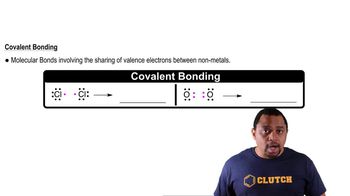
Covalent bonds are formed when two atoms share electrons, typically between nonmetals. The degree of sharing can vary, leading to polar or nonpolar covalent bonds. Nonpolar covalent bonds occur when the atoms involved have similar electronegativities, resulting in an equal sharing of electrons.
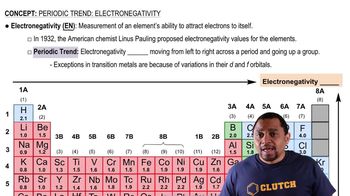
Electronegativity is a measure of an atom's ability to attract and hold onto electrons in a bond. The difference in electronegativity between two bonded atoms determines the bond's polarity. If the difference is small (generally less than 0.4), the bond is considered nonpolar covalent, while larger differences indicate polar covalent or ionic bonds.
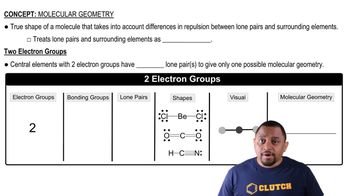
Molecular geometry refers to the three-dimensional arrangement of atoms within a molecule. The shape of a molecule can influence its polarity; symmetrical molecules with identical bonds often exhibit nonpolar characteristics. Understanding the geometry helps in predicting whether a molecule will have a net dipole moment, which is crucial for identifying nonpolar substances.


 검증된 단계별 안내
 02:03
02:03