Ch.7 - Covalent Bonding and Electron-Dot Structures
McMurry - Chemistry 8th Edition
McMurry8th EditionChemistryISBN: 9781292336145당신이 사용하는 게 아니라요?교과서 변경
7장, 문제 87

The estimated lattice energy for CsF21s2 is +2347 kJ/mol. Use the data given in Problem 6.86 to calculate an overall energy change in kilojoules per mole for the formation of CsF21s2 from its elements. Does the overall reaction absorb energy or release it? In light of your answer to Problem 6.86, which compound is more likely to form in the reaction of cesium with fluorine, CsF or CsF2?Table showing energy values for copper and chlorine in the Born Haber cycle.

검증된 단계별 안내
1
Identify the given data and the required data from Problem 6.86. The table provides the enthalpy of sublimation (ΔH_sub), first ionization energy (IE1), second ionization energy (IE2), bond dissociation energy (BDE), electron affinity (EA), and lattice energy (LE) for the formation of CuCl2.
Write the formation reaction for CsF2 from its elements: Cs(s) + F2(g) → CsF2(s).
Determine the enthalpy changes for each step in the formation of CsF2 using the Born-Haber cycle. This includes the sublimation of Cs, the ionization energies of Cs, the bond dissociation energy of F2, the electron affinity of F, and the lattice energy of CsF2.
Sum the enthalpy changes for each step to find the overall energy change for the formation of CsF2.
Compare the overall energy change for the formation of CsF2 with the lattice energy of CsF to determine which compound is more likely to form. If the overall energy change is positive, the reaction absorbs energy; if negative, it releases energy.

비슷한 문제에 대한 검증된 영상 답변:

이 영상 해법은 위 문제에 도움이 된다고 튜터들이 추천한 것입니다.
영상 길이:
3m
도움이 되었나요?

주요 개념

질문에 올바르게 답하기 위해 반드시 이해해야 하는 핵심 개념들은 다음과 같습니다.

Lattice Energy

Lattice energy is the amount of energy released when gaseous ions combine to form an ionic solid. It is a measure of the strength of the forces between the ions in an ionic compound. A higher lattice energy indicates a more stable ionic compound, as it reflects stronger ionic bonds. In the context of CsF21s2, the positive lattice energy value suggests that energy is required to form the solid from its gaseous ions.
추천 영상:

Born-Haber Cycle

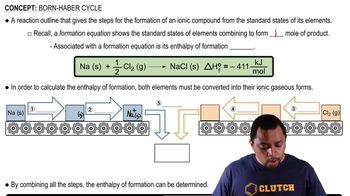
The Born-Haber cycle is a thermodynamic cycle that relates the lattice energy of an ionic compound to other energy changes involved in its formation. It includes steps such as sublimation, ionization, bond dissociation, and electron affinity. By applying Hess's law, the cycle allows for the calculation of lattice energy using known enthalpy changes, providing insight into the overall energy changes during the formation of ionic compounds like CsF and CsF2.
추천 영상:
가이드 코스
03:49
Born Haber Cycle

Enthalpy Change

Enthalpy change refers to the heat content change of a system at constant pressure during a chemical reaction. It can be positive (endothermic) or negative (exothermic), indicating whether the reaction absorbs or releases energy. In the formation of CsF21s2, calculating the overall enthalpy change will help determine if the reaction is energetically favorable and whether CsF or CsF2 is more likely to form based on the energy balance.
추천 영상:
가이드 코스
02:34
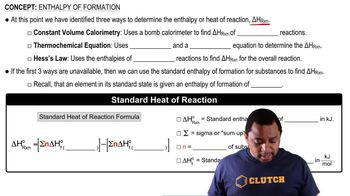
Enthalpy of Formation
관련 실천
교과서 질문
Some mothballs used when storing clothes are made of naphthalene (C10H8), which has the following incomplete structure.

(a) Add double bonds where needed to draw a complete electron-dot structure.
348
views

교과서 질문

Draw as many resonance structures as you can for the following nitrogen-containing compounds. Not all will obey the octet rule. Use curved arrows to depict the conversion of one structure into another. (d) N2O3(ONNO2)

759
views
교과서 질문
Draw three resonance structures for sulfur tetroxide, SO4, whose connections are shown below. (This is a neutral mol-ecule; it is not a sulfate ion.) Assign formal charges to the atoms in each structure.
822
views
교과서 질문

Draw as many resonance structures as you can for the following nitrogen-containing compounds. Not all will obey the octet rule. Use curved arrows to depict the conversion of one structure into another. (b) NO

513
views
교과서 질문
Which of the following pairs of structures represent resonance forms, and which do not? (a)
762
views
교과서 질문
Benzene has the following structural formula.

(b) Which statement best describes the carbon–carbon bonds in benzene? (i) Three carbon–carbon bonds are longer and weaker than the other three carbon–carbon bonds. (ii) All six carbon–carbon bonds are identical, and their length and strength are between a double and single bond. (iii) The length of carbon–carbon double bond switches back and forth between the length of a double and a single bond.
422
views