Ch.7 - Covalent Bonding and Electron-Dot Structures
McMurry - Chemistry 8th Edition
McMurry8th EditionChemistryISBN: 9781292336145당신이 사용하는 게 아니라요?교과서 변경
7장, 문제 90

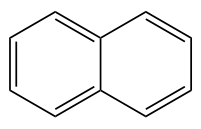
Benzene has the following structural formula. Structural formula of benzene showing its carbon-carbon bonds for resonance structures.
(b) Which statement best describes the carbon–carbon bonds in benzene? (i) Three carbon–carbon bonds are longer and weaker than the other three carbon–carbon bonds. (ii) All six carbon–carbon bonds are identical, and their length and strength are between a double and single bond. (iii) The length of carbon–carbon double bond switches back and forth between the length of a double and a single bond.

검증된 단계별 안내
1
Step 1: Understand the structure of benzene. Benzene is a cyclic hydrocarbon with the molecular formula C6H6. It has a ring structure with alternating double and single bonds between carbon atoms.
Step 2: Recognize the concept of resonance in benzene. Benzene exhibits resonance, meaning that the electrons are delocalized over the entire ring structure, creating a hybrid of the possible resonance structures.
Step 3: Analyze the given statements. Statement (i) suggests that three carbon–carbon bonds are longer and weaker than the other three, which is not consistent with the resonance structure of benzene.
Step 4: Evaluate statement (ii). This statement suggests that all six carbon–carbon bonds are identical, with lengths and strengths between those of a single and double bond, which aligns with the concept of resonance in benzene.
Step 5: Consider statement (iii). This statement suggests that the length of the carbon–carbon double bond switches back and forth, which is not accurate for benzene as the bonds are delocalized and do not switch.

비슷한 문제에 대한 검증된 영상 답변:

이 영상 해법은 위 문제에 도움이 된다고 튜터들이 추천한 것입니다.
영상 길이:
4m
도움이 되었나요?

주요 개념

질문에 올바르게 답하기 위해 반드시 이해해야 하는 핵심 개념들은 다음과 같습니다.

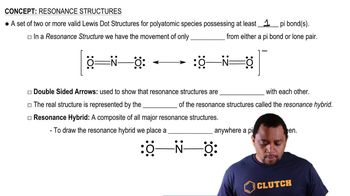
Resonance Structures

Resonance structures are different ways of drawing the same molecule that illustrate the delocalization of electrons. In benzene, the electrons in the carbon-carbon bonds are not fixed in one position but are spread out over the entire ring, leading to equivalent structures. This concept helps explain the stability and unique properties of benzene compared to alkenes.
추천 영상:
가이드 코스
01:42
Resonance Structures

Bond Length and Strength

In chemistry, bond length refers to the distance between the nuclei of two bonded atoms, while bond strength indicates the energy required to break that bond. In benzene, all carbon-carbon bonds are of equal length and strength, which is intermediate between single (longer, weaker) and double (shorter, stronger) bonds due to resonance, resulting in a stable structure.
추천 영상:
가이드 코스
00:36
Average Bond Order

Hybridization

Hybridization is the concept of mixing atomic orbitals to form new hybrid orbitals that can accommodate bonding. In benzene, the carbon atoms are sp² hybridized, which allows for the formation of three sigma bonds and one unhybridized p orbital. This p orbital participates in the delocalized pi bonding that characterizes the resonance in benzene.
추천 영상: