Ch.7 - Covalent Bonding and Electron-Dot Structures
McMurry - Chemistry 8th Edition
McMurry8th EditionChemistryISBN: 9781292336145당신이 사용하는 게 아니라요?교과서 변경
7장, 문제 33

Two electrostatic potential maps are shown, one of methyl-lithium (CH3Li) and the other of chloromethane (CH3Cl). Based on their polarity patterns, which do you think is which? (a)
Electrostatic potential map of methyl-lithium (CH3Li) showing polarity patterns.
(b)

검증된 단계별 안내
1
Identify the elements in each molecule: CH3Li (methyl-lithium) and CH3Cl (chloromethane).
Understand the concept of electronegativity: Chlorine (Cl) is more electronegative than Carbon (C), and Carbon is more electronegative than Lithium (Li).
Analyze the electrostatic potential maps: Red regions indicate areas of negative charge (high electron density), while blue regions indicate areas of positive charge (low electron density).
Compare the maps: In map A, the red region is around the carbon atom, indicating a higher electron density near carbon. In map B, the red region is around the chlorine atom, indicating a higher electron density near chlorine.
Conclude the identification: Map A corresponds to CH3Li (methyl-lithium) because the carbon is more electronegative than lithium, and map B corresponds to CH3Cl (chloromethane) because chlorine is more electronegative than carbon.

비슷한 문제에 대한 검증된 영상 답변:

이 영상 해법은 위 문제에 도움이 된다고 튜터들이 추천한 것입니다.
영상 길이:
1m
도움이 되었나요?

주요 개념

질문에 올바르게 답하기 위해 반드시 이해해야 하는 핵심 개념들은 다음과 같습니다.

Electrostatic Potential Maps

Electrostatic potential maps visually represent the distribution of electron density in a molecule, indicating areas of positive and negative charge. These maps use color gradients, where red typically indicates regions of high electron density (negative potential) and blue indicates low electron density (positive potential). Understanding these maps is crucial for analyzing molecular polarity and predicting reactivity.
추천 영상:
가이드 코스
00:34
Kinetic & Potential Energy

Polarity of Molecules

Polarity in molecules arises from differences in electronegativity between atoms, leading to uneven distribution of electron density. Polar molecules have a significant dipole moment due to the presence of polar bonds, which can affect their physical properties and interactions. Recognizing the polarity of methyl-lithium and chloromethane is essential for interpreting their electrostatic potential maps.
추천 영상:
가이드 코스
02:38
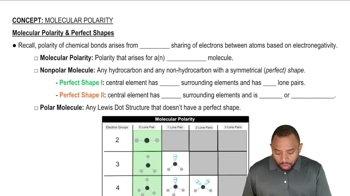
Molecular Polarity

Comparison of Methyl-Lithium and Chloromethane

Methyl-lithium (CH3Li) is an organolithium compound that exhibits significant ionic character, making it highly polar, while chloromethane (CH3Cl) is a polar covalent molecule due to the electronegativity difference between carbon and chlorine. Analyzing the electrostatic potential maps allows for distinguishing between these two compounds based on their charge distributions and polarity patterns.
추천 영상:
가이드 코스
2:38
Atomic Mass Comparison Example
관련 실천
교과서 질문

Electrostatic potential maps of acetaldehyde (C2H4), ethane (C2H6), ethanol (C2H6O), and fluorethane (C2H5F) are shown. Which do you think is which? (a)

(b)

(c)

(d)

465
views

교과서 질문
The following ball-and-stick molecular model is a representation of thalidomide, a drug that causes birth defects when taken by expectant mothers but is valuable for its use against leprosy. The lines indicate only the connections between atoms, not whether the bonds are single, double, or triple. (Red = O, gray = C, blue = N, ivory = H). Give the formula of thalidomide, and indicate the positions of multiple bonds and lone pairs.

667
views
교과서 질문
Characterize bonds between the two atoms as covalent or ionic. (a) Cl and F (b) Rb and F (c) Na and S (d) N and S
522
views
교과서 질문
The following diagram shows the potential energy of two atoms as a function of internuclear distance. Which bond is the strongest? Which bond is the longest?

1175
views
교과서 질문
The following diagram shows the potential energy of two atoms as a function of internuclear distance. Match the descriptions with the indicated letter on the plot. (a) Repulsive forces are high between the two atoms. (b) The two atoms neither exert attractive nor repulsive forces on one another. (c) The attractive forces between atoms are maximized, resulting in the lowest energy state. (d) Attractive forces between atoms are present but are not at maximum strength.

1242
views
교과서 질문
Which of the following alkali metal halides has the largest lat-tice energy? Explain. (a) (b) (c)
343
views