Ch.7 - Covalent Bonding and Electron-Dot Structures
McMurry - Chemistry 8th Edition
McMurry8th EditionChemistryISBN: 9781292336145당신이 사용하는 게 아니라요?교과서 변경
7장, 문제 29

Which of the following alkali metal halides has the largest lat-tice energy? Explain. (a) (b) (c)

검증된 단계별 안내
1
Identify the alkali metals and halides involved in each option (a), (b), and (c).
Understand that lattice energy is influenced by the charge of the ions and the distance between them. The greater the charge and the smaller the ionic radii, the stronger the lattice energy.
Recall that in the periodic table, as you move down a group, the ionic radius increases. This means that for alkali metals, the ionic radius increases from Li to Cs.
Similarly, for halides, the ionic radius increases as you move down the group in the periodic table, from F to I.
Compare the alkali metals and halides in each option based on their positions in the periodic table to determine which combination has the smallest ions with the highest charges, as this will likely have the largest lattice energy.

비슷한 문제에 대한 검증된 영상 답변:

이 영상 해법은 위 문제에 도움이 된다고 튜터들이 추천한 것입니다.
영상 길이:
2m
도움이 되었나요?

주요 개념

질문에 올바르게 답하기 위해 반드시 이해해야 하는 핵심 개념들은 다음과 같습니다.

Lattice Energy

Lattice energy is the amount of energy released when gaseous ions combine to form an ionic solid. It is a measure of the strength of the forces between the ions in an ionic compound. Higher lattice energy indicates stronger ionic bonds, which typically results from smaller ionic radii and higher charges on the ions.
추천 영상:

Ionic Size and Charge

The size of the ions involved in the formation of an ionic compound significantly affects lattice energy. Smaller ions can pack more closely together, leading to stronger electrostatic attractions and higher lattice energy. Additionally, the charge of the ions plays a crucial role; ions with higher charges will produce greater lattice energy due to stronger interactions.
추천 영상:

Trends in Alkali Metal Halides

In alkali metal halides, lattice energy trends can be analyzed based on the alkali metal and halide involved. As you move down the group of alkali metals, the ionic size increases, leading to lower lattice energies. Conversely, halides with higher electronegativity (like fluorine) tend to form compounds with higher lattice energies due to their smaller ionic size compared to other halides.
추천 영상:
가이드 코스
01:08
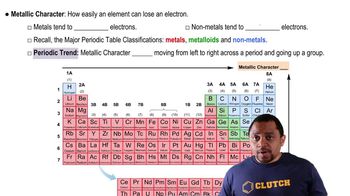
Metallic Character Trends
관련 실천
교과서 질문
Which is the best electron-dot structure for the thiosulfate ion (S2O3 2-) based on the rules of formal charge? (LO 7.16) (a) (b) (c) (d)
576
views

교과서 질문

Use formal charge to select which resonance structure makes the largest contribution to the resonance hybrid. (LO 7.16) (a) Structure I (b) Structure II (c) Structure III (d) All structures are equivalent and make the same contri-bution to the resonance hybrid. (I)

(II)

(III)

606
views
교과서 질문
What is the best prediction for the carbon–oxygen bond length in the carbonate anion, CO3 2-? (LO 7.14) Data for average carbon-oxygen bond lengths: (a) 143 pm (b) 132 pm (c) 121 pm (d) 118 pm
736
views
교과서 질문

Two electrostatic potential maps are shown, one of methyl-lithium (CH3Li) and the other of chloromethane (CH3Cl). Based on their polarity patterns, which do you think is which? (a)

(b)

498
views
교과서 질문
The following diagram shows the potential energy of two atoms as a function of internuclear distance. Which bond is the strongest? Which bond is the longest?

1175
views
교과서 질문
The following diagram shows the potential energy of two atoms as a function of internuclear distance. Match the descriptions with the indicated letter on the plot. (a) Repulsive forces are high between the two atoms. (b) The two atoms neither exert attractive nor repulsive forces on one another. (c) The attractive forces between atoms are maximized, resulting in the lowest energy state. (d) Attractive forces between atoms are present but are not at maximum strength.

1242
views