Ch.7 - Covalent Bonding and Electron-Dot Structures
McMurry - Chemistry 8th Edition
McMurry8th EditionChemistryISBN: 9781292336145당신이 사용하는 게 아니라요?교과서 변경
7장, 문제 96

Use the following information plus the data given in Tables 6.2 and 6.3 to calculate the second electron affinity, Eea2, of oxygen. Is the O2-ion stable in the gas phase? Why is it stable in solid MgO? Heat of sublimation for Mg1s2 = +147.7 kJ/mol Bond dissociation energy for O21g2 = +498.4 kJ/mol Eea1 for O1g2 = -141.0 kJ/mol Net energy change for formation of MgO(s) from its elements = -601.7 kJ/mol

검증된 단계별 안내
1
Identify the relevant thermodynamic processes involved in the formation of the O^{2-} ion and the formation of MgO(s).
Use Hess's Law to relate the given energies to the second electron affinity, E_{ea2}, of oxygen. Consider the following steps: (1) Sublimation of Mg(s) to Mg(g), (2) Ionization of Mg(g) to Mg^{2+}(g), (3) Dissociation of O_2(g) to 2 O(g), (4) First electron affinity of O(g) to form O^-(g), (5) Second electron affinity of O^-(g) to form O^{2-}(g), and (6) Lattice energy of MgO(s).
Write the equation for the formation of MgO(s) from its elements: Mg(s) + 1/2 O_2(g) -> MgO(s).
Express the net energy change for the formation of MgO(s) in terms of the sum of the energies of the individual steps, including the unknown E_{ea2}.
Solve for E_{ea2} using the given net energy change for the formation of MgO(s) and the energies of the other steps. Discuss the stability of O^{2-} in the gas phase and in solid MgO based on the calculated E_{ea2} and lattice energy.

비슷한 문제에 대한 검증된 영상 답변:

이 영상 해법은 위 문제에 도움이 된다고 튜터들이 추천한 것입니다.
영상 길이:
4m
도움이 되었나요?

주요 개념

질문에 올바르게 답하기 위해 반드시 이해해야 하는 핵심 개념들은 다음과 같습니다.

Electron Affinity

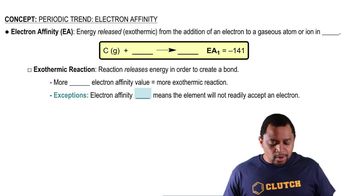
Electron affinity refers to the energy change that occurs when an electron is added to a neutral atom in the gas phase. For oxygen, the first electron affinity (Eea1) is negative, indicating that energy is released when an electron is added, while the second electron affinity (Eea2) is typically positive, as adding a second electron to a negatively charged ion requires energy due to repulsion between the two negative charges.
추천 영상:
가이드 코스
01:34
Electron Affinity

Stability of Ions

The stability of ions, such as the O2- ion, depends on the balance between the energy required to form the ion and the energy released during its formation. In the gas phase, the O2- ion may be unstable due to the high energy cost of adding a second electron. However, in a solid like MgO, the lattice energy released during the formation of the ionic compound can stabilize the O2- ion, making it energetically favorable.
추천 영상:
가이드 코스
03:13
Intepreting the Band of Stability

Lattice Energy

Lattice energy is the energy released when gaseous ions combine to form an ionic solid. In the case of MgO, the strong electrostatic attraction between Mg2+ and O2- ions results in a significant release of energy when the solid forms. This release of energy can compensate for the energy required to add an electron to the O- ion, thus stabilizing the O2- ion in the solid state despite its potential instability in the gas phase.
추천 영상: