Ch.7 - Covalent Bonding and Electron-Dot Structures
McMurry - Chemistry 8th Edition
McMurry8th EditionChemistryISBN: 9781292336145당신이 사용하는 게 아니라요?교과서 변경
7장, 문제 93

Four different structures (a), (b), (c), and (d) can be drawn for compounds named dibromobenzene, but only three different compounds actually exist. Explain. (a) Resonance structure (a) of dibromobenzene showing bromine atoms in one position.
(b) Resonance structure (b) of dibromobenzene with bromine atoms in a different position.
(c) Resonance structure (c) of dibromobenzene illustrating another arrangement of bromine atoms.
(d) Resonance structure (d) of dibromobenzene depicting a fourth arrangement of bromine atoms.

검증된 단계별 안내
1
Identify the positions of the bromine atoms in each of the four structures (a), (b), (c), and (d).
Recognize that the benzene ring has six carbon atoms, and the positions of the substituents can be described as ortho (adjacent), meta (one carbon apart), or para (opposite).
Determine the relative positions of the bromine atoms in each structure: (a) ortho, (b) meta, (c) meta, and (d) para.
Notice that structures (b) and (c) are actually the same compound because they both have bromine atoms in the meta positions, making them indistinguishable from each other.
Conclude that only three distinct compounds exist: ortho-dibromobenzene, meta-dibromobenzene, and para-dibromobenzene.

비슷한 문제에 대한 검증된 영상 답변:

이 영상 해법은 위 문제에 도움이 된다고 튜터들이 추천한 것입니다.
영상 길이:
1m
도움이 되었나요?

주요 개념

질문에 올바르게 답하기 위해 반드시 이해해야 하는 핵심 개념들은 다음과 같습니다.

Isomerism

Isomerism refers to the phenomenon where two or more compounds have the same molecular formula but different structural arrangements. In the case of dibromobenzene, the different positions of the bromine atoms on the benzene ring lead to distinct isomers, which can exhibit different physical and chemical properties.
추천 영상:
가이드 코스
2:14
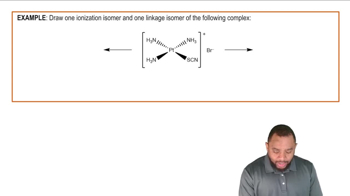
Isomerism in Coordination Complexes Example

Symmetry and Chirality

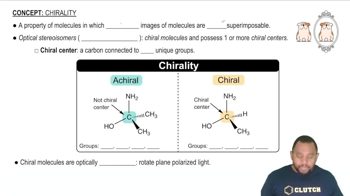
Symmetry plays a crucial role in determining the existence of distinct compounds. In dibromobenzene, certain arrangements of bromine atoms may lead to symmetrical structures that are indistinguishable from one another, resulting in fewer unique compounds than the number of possible structures. Chirality, or lack thereof, can also influence the number of isomers.
추천 영상:

Resonance Structures

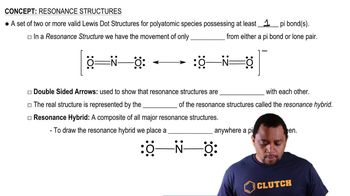
Resonance structures are different ways of representing the same molecule, where the actual structure is a hybrid of these forms. For dibromobenzene, while multiple resonance structures can be drawn, they may not correspond to unique compounds if they represent the same arrangement of atoms. Understanding resonance helps clarify why only three distinct compounds exist despite four possible structures.
추천 영상:
가이드 코스
01:42
Resonance Structures
관련 실천
교과서 질문
Some mothballs used when storing clothes are made of naphthalene (C10H8), which has the following incomplete structure.

(a) Add double bonds where needed to draw a complete electron-dot structure.
348
views

교과서 질문

Assign formal charges to the atoms in the following structures. Which of the two do you think is the more important contributor to the resonance hybrid?(a)(b)

459
views
교과서 질문
Draw three resonance structures for sulfur tetroxide, SO4, whose connections are shown below. (This is a neutral mol-ecule; it is not a sulfate ion.) Assign formal charges to the atoms in each structure.
822
views
교과서 질문
Draw the resonance structure indicated by the curved arrows. Assign formal charges, and evaluate which of the two structures is a larger contributor to the resonance hybrid.

900
views
교과서 질문
Benzene has the following structural formula.

(b) Which statement best describes the carbon–carbon bonds in benzene? (i) Three carbon–carbon bonds are longer and weaker than the other three carbon–carbon bonds. (ii) All six carbon–carbon bonds are identical, and their length and strength are between a double and single bond. (iii) The length of carbon–carbon double bond switches back and forth between the length of a double and a single bond.
422
views
교과서 질문
Use the following information plus the data given in Tables 6.2 and 6.3 to calculate the second electron affinity, Eea2, of oxygen. Is the O2-ion stable in the gas phase? Why is it stable in solid MgO? Heat of sublimation for Mg1s2 = +147.7 kJ/mol Bond dissociation energy for O21g2 = +498.4 kJ/mol Eea1 for O1g2 = -141.0 kJ/mol Net energy change for formation of MgO(s) from its elements = -601.7 kJ/mol
490
views