Ch.8 - Covalent Compounds: Bonding Theories and Molecular Structure
McMurry - Chemistry 8th Edition
McMurry8th EditionChemistryISBN: 9781292336145당신이 사용하는 게 아니라요?교과서 변경
8장, 문제 52

Oceanographers study the mixing of water masses by releasing tracer molecules at a site and then detecting their presence at other places. The molecule trifluoromethylsulfur pentafluoride is one such tracer. Draw an electron-dot structure for CF3SF5, and predict the bond angles around both carbon and sulfur.

검증된 단계별 안내
1
First, determine the total number of valence electrons available for CF3SF5. Carbon (C) has 4, each fluorine (F) has 7, sulfur (S) has 6. Since there are three fluorines and five fluorines bonded to sulfur, calculate the total by adding these values together.
Next, draw the skeleton structure of the molecule. Place carbon in the center and attach the three fluorine atoms to it. Then, connect the sulfur atom to the carbon, and attach the remaining five fluorine atoms to the sulfur.
Now, complete the octets around each of the fluorine and sulfur atoms by adding lone pairs. Each fluorine should have three lone pairs, and sulfur should have one lone pair to complete its octet.
After completing the structure, use the VSEPR theory to predict the shapes and bond angles. For the carbon atom, which is bonded to three fluorine atoms and one sulfur atom, the shape will be tetrahedral with bond angles close to 109.5°.
For the sulfur atom, which is bonded to five fluorine atoms, the shape will be trigonal bipyramidal. The bond angles between the equatorial fluorines will be 120°, and the angles between the axial and equatorial fluorines will be approximately 90°.

비슷한 문제에 대한 검증된 영상 답변:

이 영상 해법은 위 문제에 도움이 된다고 튜터들이 추천한 것입니다.
영상 길이:
3m

주요 개념

질문에 올바르게 답하기 위해 반드시 이해해야 하는 핵심 개념들은 다음과 같습니다.

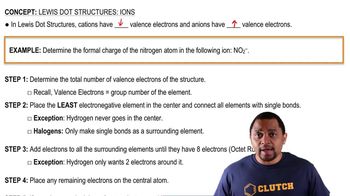
Electron-Dot Structures

Electron-dot structures, also known as Lewis structures, represent the valence electrons of atoms within a molecule. They illustrate how atoms are bonded together and can help predict molecular geometry. In the case of CF3SF5, the structure will show the arrangement of carbon, fluorine, and sulfur atoms, along with their bonding and lone pairs of electrons.
추천 영상:
가이드 코스
04:28
Lewis Dot Structures: Ions

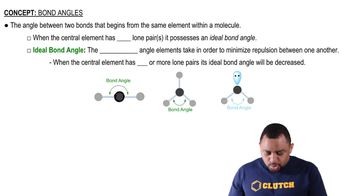
Molecular Geometry and Bond Angles

Molecular geometry refers to the three-dimensional arrangement of atoms in a molecule, which influences its physical and chemical properties. The bond angles are determined by the repulsion between electron pairs around a central atom. For CF3SF5, understanding the geometry around carbon and sulfur will help predict the bond angles based on their hybridization and the number of surrounding atoms.
추천 영상:

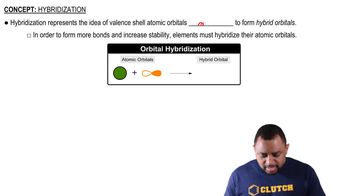
Hybridization

Hybridization is the concept of mixing atomic orbitals to form new hybrid orbitals that can accommodate bonding. In CF3SF5, carbon undergoes sp3 hybridization due to its four bonding pairs, while sulfur may exhibit sp3d hybridization due to its five bonding pairs. This hybridization affects the molecular shape and the angles between bonds, which are crucial for predicting the structure of the molecule.
추천 영상: