What bond angles do you expect for each of the following?
(d) The O¬B¬O angle in BO33-
검증된 단계별 안내
1
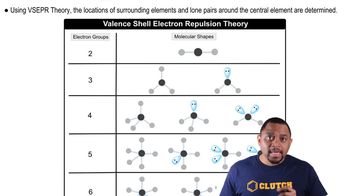
Identify the molecular geometry of the BO3^3- ion. This ion has a central boron atom (B) bonded to three oxygen atoms (O) with no lone pairs on the boron atom. According to VSEPR theory, this arrangement leads to a trigonal planar molecular geometry.
Recall that in a trigonal planar molecular geometry, all the atoms are in the same plane, and the central atom is equidistant from all surrounding atoms.
Understand that in a trigonal planar geometry, the bond angles are determined by the equal repulsion between the bonding pairs of electrons around the central atom.
Recognize that the ideal bond angle in a trigonal planar geometry is 120 degrees. This is because the geometry allows for the bonding electron pairs to be as far apart as possible, minimizing electron pair repulsion.
Conclude that the O-B-O bond angle in the BO3^3- ion is expected to be approximately 120 degrees.
비슷한 문제에 대한 검증된 영상 답변:
이 영상 해법은 위 문제에 도움이 된다고 튜터들이 추천한 것입니다.
영상 길이:
2m
영상 재생:
0 댓글
주요 개념
질문에 올바르게 답하기 위해 반드시 이해해야 하는 핵심 개념들은 다음과 같습니다.
VSEPR Theory
Valence Shell Electron Pair Repulsion (VSEPR) Theory is a model used to predict the geometry of molecules based on the repulsion between electron pairs in the valence shell of the central atom. According to VSEPR, electron pairs, whether bonding or lone pairs, will arrange themselves to minimize repulsion, leading to specific bond angles characteristic of different molecular shapes.
Trigonal planar geometry occurs when a central atom is bonded to three other atoms and has no lone pairs of electrons. This arrangement results in bond angles of approximately 120 degrees, as the three bonding pairs spread out evenly in a plane to minimize repulsion, creating a flat, triangular shape.
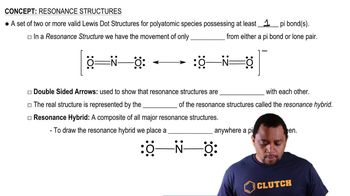
Resonance structures are different ways of drawing the same molecule that illustrate the delocalization of electrons. In the case of the borate ion (BO3^3-), resonance indicates that the actual structure is a hybrid of these forms, affecting the bond angles and lengths. This delocalization can influence the expected bond angles, as the electron density is spread over multiple bonds.


 검증된 단계별 안내
 02:13
02:13