
Ch.8 - Covalent Compounds: Bonding Theories and Molecular Structure
McMurry - Chemistry 8th Edition
McMurry8th EditionChemistryISBN: 9781292336145당신이 사용하는 게 아니라요?교과서 변경
8장, 문제 15

The C2 molecule has a MO diagram similar to N2 (Figure 8.22a). What is the bond order of C2 and is it paramagnetic or diamagnetic? (LO 8.12) (a) Bond order = 2, diamagnetic (b) Bond order = 2, paramagnetic (c) Bond order = 0, paramagnetic (d) Bond order = 3>2, diamagnetic

검증된 단계별 안내
1
Step 1: To determine the bond order and magnetic property of a molecule, we need to understand its molecular orbital (MO) diagram. The MO diagram of C2 is similar to that of N2. In the MO diagram, we fill the molecular orbitals with the total number of valence electrons from both carbon atoms. Each carbon atom has 4 valence electrons, so we have a total of 8 electrons to fill in the MO diagram.
Step 2: The filling order of the molecular orbitals is as follows: σ1s, σ*1s, σ2s, σ*2s, π2p, σ2p, π*2p, σ*2p. Fill the orbitals from lowest to highest energy until all 8 electrons are used. Remember that each orbital can hold a maximum of 2 electrons and the π2p orbital is doubly degenerate, meaning it can hold 4 electrons.
Step 3: After filling the orbitals, calculate the bond order. The bond order is given by the formula: (number of electrons in bonding orbitals - number of electrons in antibonding orbitals) / 2.
Step 4: To determine whether the molecule is paramagnetic or diamagnetic, look at the number of unpaired electrons in the MO diagram. If there are unpaired electrons, the molecule is paramagnetic. If all electrons are paired, the molecule is diamagnetic.
Step 5: Apply the information from steps 3 and 4 to the given answer choices to find the correct one. Remember not to calculate the final result, but use the steps to guide you to the correct answer.

비슷한 문제에 대한 검증된 영상 답변:

이 영상 해법은 위 문제에 도움이 된다고 튜터들이 추천한 것입니다.
영상 길이:
3m

주요 개념

질문에 올바르게 답하기 위해 반드시 이해해야 하는 핵심 개념들은 다음과 같습니다.

Molecular Orbital Theory

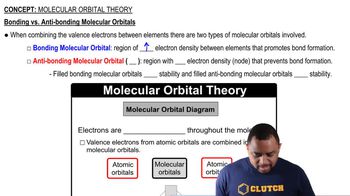
Molecular Orbital (MO) Theory describes the behavior of electrons in molecules, where atomic orbitals combine to form molecular orbitals that can be occupied by electrons. These orbitals are classified as bonding, antibonding, or non-bonding, and their occupancy determines the stability and properties of the molecule, including bond order and magnetic behavior.
추천 영상:
가이드 코스
03:06
Molecular Orbital Theory

Bond Order

Bond order is a measure of the number of chemical bonds between a pair of atoms, calculated as the difference between the number of bonding and antibonding electrons divided by two. A higher bond order indicates a stronger bond and greater stability of the molecule. For example, a bond order of 2 suggests a double bond.
추천 영상:
가이드 코스
00:36
Average Bond Order

Paramagnetism and Diamagnetism

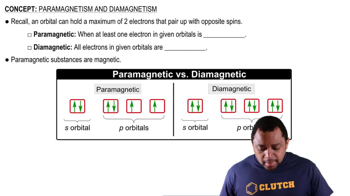
Paramagnetism and diamagnetism are terms that describe the magnetic properties of substances based on their electron configurations. Paramagnetic substances have unpaired electrons, making them attracted to magnetic fields, while diamagnetic substances have all paired electrons, causing them to be weakly repelled by magnetic fields. The presence of unpaired electrons is crucial for determining a molecule's magnetic behavior.
추천 영상:
가이드 코스
01:33
Paramagnetism and Diamagnetism
관련 실천
교과서 질문
Use the chemical structure for Tagamet, a drug used to treat peptic ulcers and heartburn, to answer questions 8 and 9.

Which orbitals overlap to form bond 2? (LO 8.5) (a) C (sp) with C (sp) (b) C (sp) with C 1sp22 (c) C 1sp22 with C 1sp22 (d) C 1sp32 with C 1sp22
288
views
교과서 질문
Use the chemical structure for Tagamet, a drug used to treat peptic ulcers and heartburn, to answer questions 8 and 9.

Which orbitals overlap to form bond 1? (LO 8.5) (a) s bond: N 1sp22 with C 1sp22; p bond: N (p) with C (p) (b) N 1sp22 with C 1sp22 (c) s bond: N 1sp22 with C 1sp22; p bond: N 1sp22 with C 1sp22 (d) s bond: N (sp) with C 1sp22; p bond: N (p) with C (p)
471
views
교과서 질문
The connections between atoms in the amino acid histidine are shown. Complete the electron-dot structure by adding multiple bonds and lone pairs of electrons. Give the hybridization on the numbered carbon and nitrogen atoms. (LO 8.4)

(a) N1 = sp2, N2 = sp, C1 = sp2, C2 = sp3 (b) N1 = sp2, N2 = sp2, C1 = sp3, C2 = sp2 (c) N1 = sp3, N2 = sp, C1 = sp2, C2 = sp3 (d) N1 = sp3, N2 = sp2, C1 = sp2, C2 = sp3
663
views
교과서 질문

Three of the following molecular models have a tetrahedral central atom, and one does not. Which is the odd one? (There may be a 'hidden' atom directly behind a visible atom in some cases.) (a)

(b)

(c)

(d)

494
views
교과서 질문
What is the geometry around the central atom in each of the following molecular models? (a)

676
views
교과서 질문
The VSEPR model is a simple predictive tool that is usually, but not always, correct. Take urea, for instance, a waste product excreted in animal urine:

What hybridization would you expect for the C and N atoms in urea according to the VSEPR model, and what approximate values would you expect for the various bond angles? What are the actual hybridizations and bond angles based on the molecular model shown? 1Red = O, gray = C, blue = N, ivory = H.2
650
views