
Ch.8 - Covalent Compounds: Bonding Theories and Molecular Structure
McMurry - Chemistry 8th Edition
McMurry8th EditionChemistryISBN: 9781292336145당신이 사용하는 게 아니라요?교과서 변경
8장, 문제 31

The VSEPR model is a simple predictive tool that is usually, but not always, correct. Take urea, for instance, a waste product excreted in animal urine: 3D model of urea showing atoms: red for O, gray for C, blue for N, ivory for H.
What hybridization would you expect for the C and N atoms in urea according to the VSEPR model, and what approximate values would you expect for the various bond angles? What are the actual hybridizations and bond angles based on the molecular model shown? 1Red = O, gray = C, blue = N, ivory = H.2

검증된 단계별 안내
1
Identify the central atoms in the urea molecule: carbon (C) and nitrogen (N).
Determine the steric number for each central atom. For carbon, count the number of atoms bonded to it and lone pairs. For nitrogen, do the same.
Use the steric number to predict the hybridization of each central atom. A steric number of 4 indicates sp3 hybridization, 3 indicates sp2, and 2 indicates sp hybridization.
Predict the bond angles based on the hybridization. For sp3, the bond angles are approximately 109.5 degrees; for sp2, they are approximately 120 degrees; and for sp, they are approximately 180 degrees.
Compare the predicted hybridizations and bond angles with the actual molecular model. In the model, observe the geometry around the carbon and nitrogen atoms to determine the actual hybridizations and bond angles.

비슷한 문제에 대한 검증된 영상 답변:

이 영상 해법은 위 문제에 도움이 된다고 튜터들이 추천한 것입니다.
영상 길이:
3m
도움이 되었나요?

주요 개념

질문에 올바르게 답하기 위해 반드시 이해해야 하는 핵심 개념들은 다음과 같습니다.

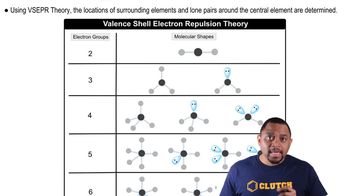
VSEPR Theory

The Valence Shell Electron Pair Repulsion (VSEPR) theory is a model used to predict the geometry of molecules based on the repulsion between electron pairs in the valence shell of atoms. According to this theory, electron pairs will arrange themselves to minimize repulsion, leading to specific molecular shapes. For urea, this model helps in predicting the arrangement of atoms around the central carbon and nitrogen atoms.
추천 영상:
가이드 코스
02:13
Molecular Shapes and VSEPR

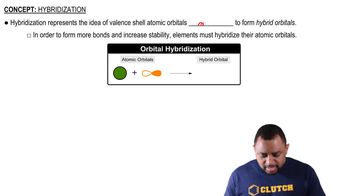
Hybridization

Hybridization is the concept of mixing atomic orbitals to form new hybrid orbitals that can accommodate the bonding requirements of a molecule. In urea, the carbon atom is typically sp² hybridized, while the nitrogen atom is sp³ hybridized. This hybridization influences the bond angles and the overall geometry of the molecule, which can be analyzed using the VSEPR model.
추천 영상:

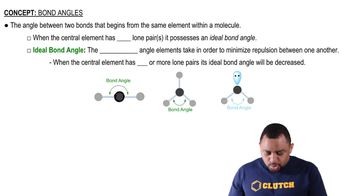
Bond Angles

Bond angles are the angles formed between adjacent bonds in a molecule, which are influenced by the hybridization of the atoms involved. In urea, the expected bond angles based on the VSEPR model would be approximately 120° for the sp² hybridized carbon and 109.5° for the sp³ hybridized nitrogen. However, actual bond angles may vary slightly due to factors such as lone pair repulsion and the presence of different atoms.
추천 영상: