Ch.8 - Covalent Compounds: Bonding Theories and Molecular Structure
McMurry - Chemistry 8th Edition
McMurry8th EditionChemistryISBN: 9781292336145당신이 사용하는 게 아니라요?교과서 변경
8장, 문제 96

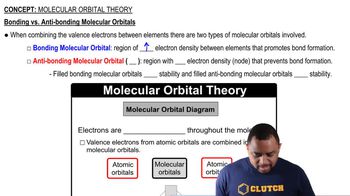
What is the difference in spatial distribution between electrons in a bonding MO and electrons in an antibonding MO?

검증된 단계별 안내
1
1. Molecular Orbitals (MOs) are formed when atomic orbitals overlap. The overlap can be constructive or destructive. Constructive overlap leads to the formation of bonding MOs, while destructive overlap leads to the formation of antibonding MOs.
2. In a bonding MO, the electron density is concentrated between the two nuclei. This is because the wave functions of the atomic orbitals combine constructively, leading to an increase in electron density between the nuclei. This increased electron density helps to hold the two nuclei together, hence the term 'bonding'.
3. On the other hand, in an antibonding MO, the electron density is found primarily outside the region between the two nuclei. This is due to the destructive combination of the wave functions of the atomic orbitals, which leads to a node (a region of zero electron density) between the nuclei. This lack of electron density between the nuclei does not help to hold them together, hence the term 'antibonding'.
4. Therefore, the main difference in spatial distribution between electrons in a bonding MO and electrons in an antibonding MO is that in a bonding MO, the electron density is concentrated between the nuclei, while in an antibonding MO, the electron density is found outside the region between the nuclei.
5. This difference in spatial distribution is crucial as it determines whether a molecular orbital will contribute to the formation of a chemical bond (in the case of a bonding MO) or hinder it (in the case of an antibonding MO).

비슷한 문제에 대한 검증된 영상 답변:

이 영상 해법은 위 문제에 도움이 된다고 튜터들이 추천한 것입니다.
영상 길이:
1m
도움이 되었나요?

주요 개념

질문에 올바르게 답하기 위해 반드시 이해해야 하는 핵심 개념들은 다음과 같습니다.

Molecular Orbitals (MOs)

Molecular orbitals are formed by the combination of atomic orbitals when atoms bond together. They can be classified as bonding or antibonding. Bonding MOs are lower in energy and result from the constructive interference of atomic orbitals, leading to increased electron density between the nuclei, which stabilizes the molecule. Antibonding MOs, on the other hand, arise from destructive interference and have higher energy, resulting in decreased electron density between the nuclei.
추천 영상:
가이드 코스
03:06
Molecular Orbital Theory

Spatial Distribution of Electrons

The spatial distribution of electrons in molecular orbitals refers to how electron density is arranged in relation to the nuclei of the bonded atoms. In bonding MOs, electron density is concentrated in the region between the nuclei, promoting attraction and stability. Conversely, in antibonding MOs, electron density is found outside the internuclear region, which can lead to repulsion between the nuclei and destabilization of the molecule.
추천 영상:
가이드 코스
01:30
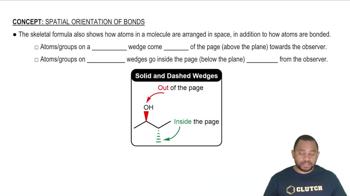
Spatial Orientation of Bonds

Energy Levels of MOs

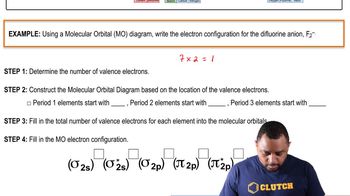
The energy levels of molecular orbitals play a crucial role in determining the stability of a molecule. Bonding MOs are lower in energy compared to the original atomic orbitals, making them favorable for electron occupancy. Antibonding MOs, being higher in energy, are less stable and can destabilize a molecule if occupied by electrons. The filling of these orbitals according to the Aufbau principle influences the overall bond order and stability of the molecule.
추천 영상:
가이드 코스
03:46
Homonuclear Diatomic Molecules MO Diagram Example