Ch.9 - Thermochemistry: Chemical Energy
McMurry - Chemistry 8th Edition
McMurry8th EditionChemistryISBN: 9781292336145당신이 사용하는 게 아니라요?교과서 변경
9장, 문제 54b

A reaction inside a cylindrical container with a movable RAN piston causes the volume to change from 12.0 L to 18.0 L while the pressure outside the container remains constant at 0.975 atm. (The volume of a cylinder is V = pr2h, where h is the height; 1 L # atm = 101.325 J.) (b) The diameter of the piston is 17.0 cm. How far does the piston move?

검증된 단계별 안내
1
Calculate the cross-sectional area of the piston using the formula for the area of a circle, \( A = \pi r^2 \), where \( r \) is the radius of the piston. Since the diameter is given as 17.0 cm, first convert this to radius by dividing by 2.
Convert the radius from centimeters to meters by dividing by 100, as the standard unit for area in the International System of Units (SI) is square meters (m^2).
Substitute the radius in meters into the area formula to find the cross-sectional area of the piston in square meters.
Calculate the change in volume, which is the final volume minus the initial volume. Convert this volume from liters to cubic meters by dividing by 1000, since 1 cubic meter equals 1000 liters.
Determine the distance the piston moved by dividing the change in volume by the cross-sectional area of the piston. This will give the height change in meters.

비슷한 문제에 대한 검증된 영상 답변:

이 영상 해법은 위 문제에 도움이 된다고 튜터들이 추천한 것입니다.
영상 길이:
6m
도움이 되었나요?

주요 개념

질문에 올바르게 답하기 위해 반드시 이해해야 하는 핵심 개념들은 다음과 같습니다.

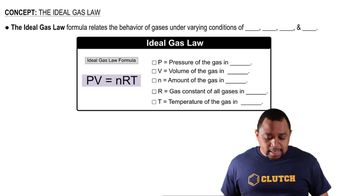
Ideal Gas Law

The Ideal Gas Law relates the pressure, volume, temperature, and number of moles of a gas through the equation PV = nRT. While this question focuses on a specific scenario involving volume change and pressure, understanding the Ideal Gas Law is essential for grasping how gases behave under varying conditions.
추천 영상:
가이드 코스
01:15
Ideal Gas Law Formula

Volume of a Cylinder

The volume of a cylinder is calculated using the formula V = πr²h, where r is the radius and h is the height. In this context, knowing how to calculate the volume change of the cylinder as the piston moves is crucial for determining the distance the piston travels.
추천 영상:
가이드 코스
02:35
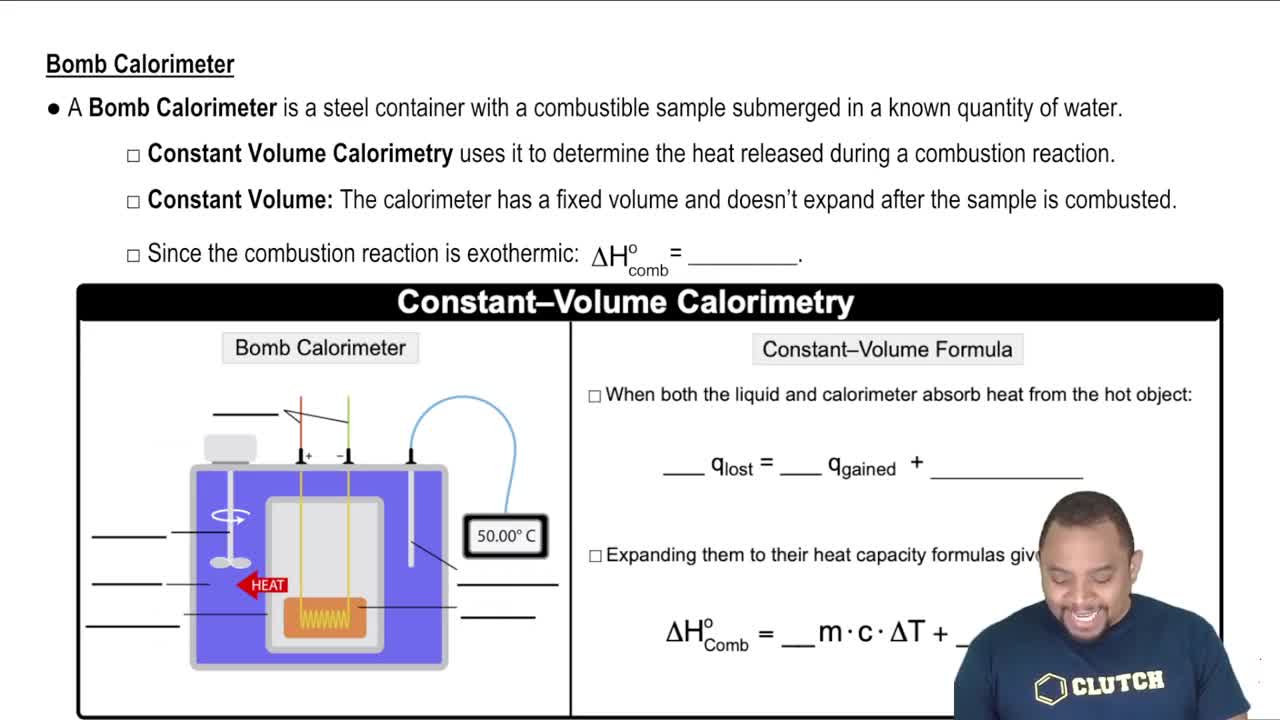
Constant-Volume Calorimetry

Work Done by a Gas

When a gas expands or contracts, it does work on its surroundings, which can be calculated using the formula W = PΔV, where W is work, P is pressure, and ΔV is the change in volume. Understanding this concept helps in analyzing the energy changes associated with the movement of the piston in the container.
추천 영상:
가이드 코스
01:52
Work Function Calculation Example
관련 실천
교과서 질문
Calculate the work done in joules by a chemical reaction if the volume increases from 3.2 L to 3.4 L against a constant external pressure of 3.6 atm. What is the sign of the energy change?
2140
views
1
rank

교과서 질문

A reaction inside a cylindrical container with a movable RAN piston causes the volume to change from 12.0 L to 18.0 L while the pressure outside the container remains constant at 0.975 atm. (The volume of a cylinder is V = pr2h, where h is the height; 1 L # atm = 101.325 J.) (a) What is the value in joules of the work w done during the reaction?

619
views
교과서 질문
Assume that the nutritional content of an apple-say, 50 Cal (1 Cal = 1000 cal) - could be used to light a light bulb. For how many minutes would there be light from each of the following? (a) A 100-watt incandescent bulb (1 W = 1 J/s)
726
views
교과서 질문

At a constant pressure of 0.905 atm, a chemical reaction takes place in a cylindrical container with a movable piston having a diameter of 40.0 cm. During the reaction, the height of the piston drops by 65.0 cm. (The volume of a cylinder is V=pr2h,wherehistheheight;1Latm=101.3J.) (a) What is the change in volume in liters during the reaction?

898
views
교과서 질문
When a sample of a hydrocarbon fuel is ignited and burned in oxygen, the internal energy decreases by 7.20 kJ. If 5670 J of heat were transferred to the surroundings, what is the sign and magnitude of work? If the reaction took place in an environ- ment with a pressure of 1 atm, what was the volume change?
1024
views
교과서 질문

At a constant pressure of 0.905 atm, a chemical reaction takes place in a cylindrical container with a movable piston having a diameter of 40.0 cm. During the reaction, the height of the piston drops by 65.0 cm. (The volume of a cylinder is V=pr2h,wherehistheheight;1Latm=101.3J.) (b) What is the value in joules of the work w done during the reaction?

577
views