Ch.9 - Thermochemistry: Chemical Energy
McMurry - Chemistry 8th Edition
McMurry8th EditionChemistryISBN: 9781292336145당신이 사용하는 게 아니라요?교과서 변경
9장, 문제 56

When a sample of a hydrocarbon fuel is ignited and burned in oxygen, the internal energy decreases by 7.20 kJ. If 5670 J of heat were transferred to the surroundings, what is the sign and magnitude of work? If the reaction took place in an environ- ment with a pressure of 1 atm, what was the volume change?

검증된 단계별 안내
1
First, we need to understand that the internal energy change of a system (ΔU) is given by the equation ΔU = q + w, where q is the heat transferred and w is the work done. In this case, we know that ΔU = -7.20 kJ and q = 5670 J. However, we need to convert q to kJ to match the units of ΔU. So, q = 5670 J * (1 kJ / 1000 J) = 5.67 kJ.
Next, we can substitute the values of ΔU and q into the equation to find w. So, -7.20 kJ = 5.67 kJ + w. Solving for w, we get w = -7.20 kJ - 5.67 kJ.
Then, we need to understand that the work done by a gas is given by the equation w = -PΔV, where P is the pressure and ΔV is the volume change. In this case, we know that P = 1 atm, but we need to convert it to the same units as w, which is kJ. So, P = 1 atm * (101.3 J / (atm*L)) * (1 kJ / 1000 J) = 0.1013 kJ/L.
Now, we can substitute the values of w and P into the equation to find ΔV. So, w = -PΔV becomes w / -P = ΔV.
Finally, we can substitute the values of w and P into the equation to find ΔV. So, ΔV = w / -P.

비슷한 문제에 대한 검증된 영상 답변:

이 영상 해법은 위 문제에 도움이 된다고 튜터들이 추천한 것입니다.
영상 길이:
11m

주요 개념

질문에 올바르게 답하기 위해 반드시 이해해야 하는 핵심 개념들은 다음과 같습니다.

First Law of Thermodynamics

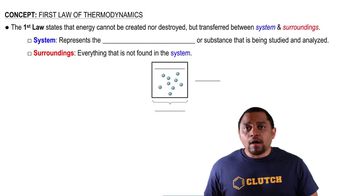
The First Law of Thermodynamics states that energy cannot be created or destroyed, only transformed from one form to another. In the context of a chemical reaction, the change in internal energy of the system is equal to the heat added to the system minus the work done by the system. This principle is crucial for understanding how energy is conserved during chemical reactions.
추천 영상:
가이드 코스
01:18
First Law of Thermodynamics

Work in Thermodynamics

In thermodynamics, work is defined as the energy transferred when a force is applied over a distance. For a gas, work can be calculated using the formula W = -PΔV, where P is the pressure and ΔV is the change in volume. Understanding how to calculate work is essential for determining the energy changes in a system during a reaction, especially when gases are involved.
추천 영상:
가이드 코스
01:18
First Law of Thermodynamics

Enthalpy and Heat Transfer

Enthalpy is a thermodynamic quantity that represents the total heat content of a system. When a reaction occurs at constant pressure, the heat transferred to or from the surroundings can be related to the change in enthalpy. In this scenario, knowing the heat transferred to the surroundings helps in calculating the work done and understanding the overall energy balance of the reaction.
추천 영상:
가이드 코스
02:34
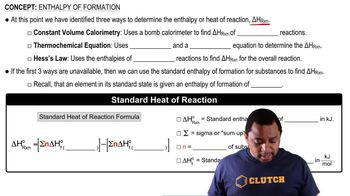
Enthalpy of Formation
관련 실천
교과서 질문
What is the difference between the internal energy change ∆E and the enthalpy change ∆H? Which of the two is mea- sured at constant pressure and which at constant volume?
1244
views

교과서 질문

A reaction inside a cylindrical container with a movable RAN piston causes the volume to change from 12.0 L to 18.0 L while the pressure outside the container remains constant at 0.975 atm. (The volume of a cylinder is V = pr2h, where h is the height; 1 L # atm = 101.325 J.) (b) The diameter of the piston is 17.0 cm. How far does the piston move?

720
views
교과서 질문
The enthalpy change for the reaction of 50.0 mL of ethylene with 50.0 mL of H2 at 1.5 atm pressure (Problem 9.51) is ∆H = -0.31 kJ. What is the value of ∆E?
891
views
교과서 질문

At a constant pressure of 0.905 atm, a chemical reaction takes place in a cylindrical container with a movable piston having a diameter of 40.0 cm. During the reaction, the height of the piston drops by 65.0 cm. (The volume of a cylinder is V=pr2h,wherehistheheight;1Latm=101.3J.) (a) What is the change in volume in liters during the reaction?

898
views
교과서 질문

At a constant pressure of 0.905 atm, a chemical reaction takes place in a cylindrical container with a movable piston having a diameter of 40.0 cm. During the reaction, the height of the piston drops by 65.0 cm. (The volume of a cylinder is V=pr2h,wherehistheheight;1Latm=101.3J.) (b) What is the value in joules of the work w done during the reaction?

577
views
교과서 질문
Under what circumstances are ΔE and ΔH essentially equal?
447
views