Ch.9 - Thermochemistry: Chemical Energy
McMurry - Chemistry 8th Edition
McMurry8th EditionChemistryISBN: 9781292336145당신이 사용하는 게 아니라요?교과서 변경
9장, 문제 124

How is it possible for a reaction to be spontaneous yet endothermic?

검증된 단계별 안내
1
Understand that a spontaneous reaction is one that occurs without needing to be driven by an external force. It is determined by the change in Gibbs free energy (ΔG).
Recall the Gibbs free energy equation: ΔG = ΔH - TΔS, where ΔG is the change in free energy, ΔH is the change in enthalpy, T is the temperature in Kelvin, and ΔS is the change in entropy.
Recognize that for a reaction to be spontaneous, ΔG must be negative.
Consider that an endothermic reaction has a positive ΔH, meaning it absorbs heat from the surroundings.
Realize that if the increase in entropy (ΔS) is large enough and the temperature (T) is high enough, the TΔS term can outweigh the positive ΔH, resulting in a negative ΔG, thus making the reaction spontaneous.

비슷한 문제에 대한 검증된 영상 답변:

이 영상 해법은 위 문제에 도움이 된다고 튜터들이 추천한 것입니다.
영상 길이:
1m
도움이 되었나요?

주요 개념

질문에 올바르게 답하기 위해 반드시 이해해야 하는 핵심 개념들은 다음과 같습니다.

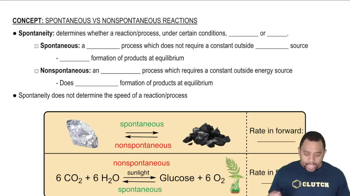
Spontaneity of Reactions

A reaction is considered spontaneous if it occurs without external intervention. This is often determined by the change in Gibbs free energy (ΔG); if ΔG is negative, the reaction is spontaneous. Spontaneity is influenced by both enthalpy (ΔH) and entropy (ΔS) changes during the reaction.
추천 영상:
가이드 코스
04:20
Spontaneity of Processes

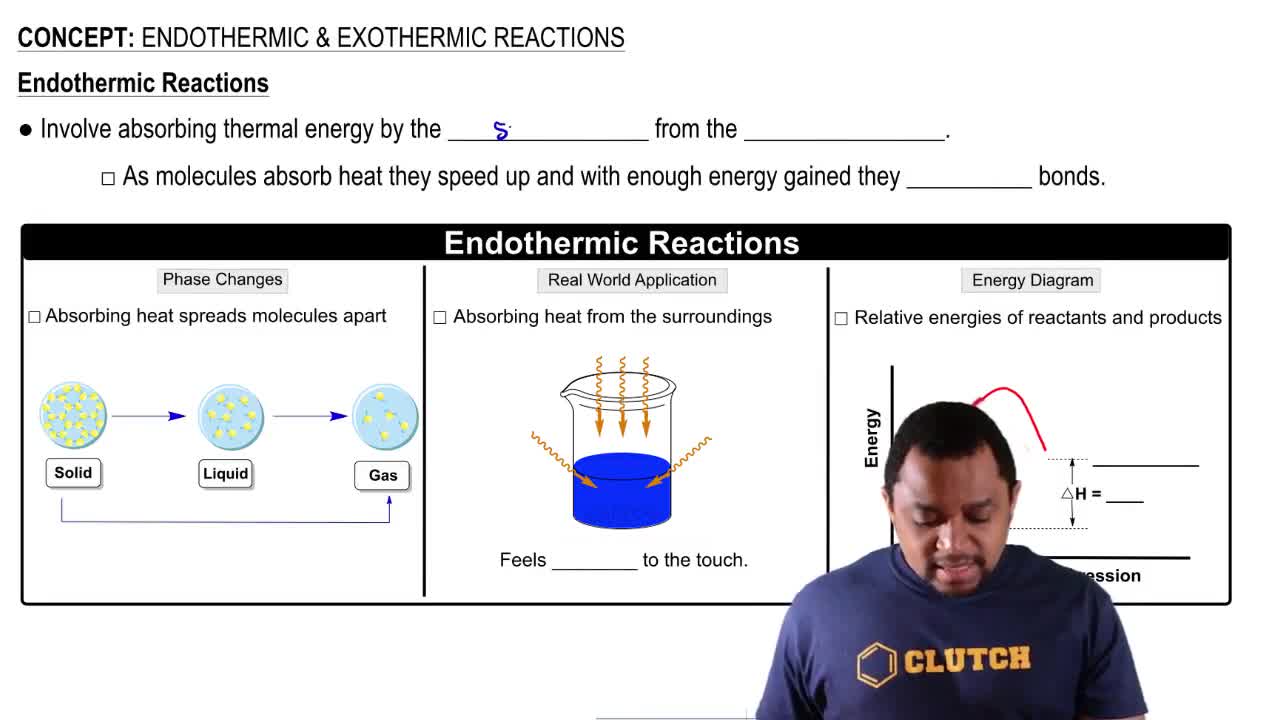
Endothermic Reactions

Endothermic reactions absorb heat from their surroundings, resulting in a positive change in enthalpy (ΔH > 0). While these reactions require energy input to proceed, they can still be spontaneous if the increase in entropy (ΔS) is sufficiently large to offset the energy absorbed, leading to a negative ΔG.
추천 영상:
가이드 코스
02:30
Endothermic & Exothermic Reactions

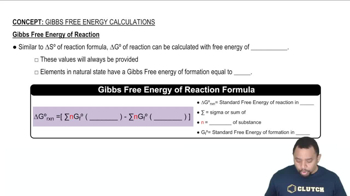
Gibbs Free Energy Equation

The Gibbs free energy equation, ΔG = ΔH - TΔS, relates the change in free energy to enthalpy and entropy changes at a given temperature (T). For a reaction to be spontaneous, the term TΔS must be greater than ΔH, allowing for a negative ΔG even when ΔH is positive, thus enabling endothermic reactions to occur spontaneously.
추천 영상:
가이드 코스
01:51
Gibbs Free Energy of Reactions