Ch.9 - Thermochemistry: Chemical Energy
McMurry - Chemistry 8th Edition
McMurry8th EditionChemistryISBN: 9781292336145당신이 사용하는 게 아니라요?교과서 변경
9장, 문제 123

What are the two terms that make up the free-energy change for a reaction, ΔG, and which of the two is usually more important?

검증된 단계별 안내
1
Step 1: Understand that the free-energy change for a reaction, denoted as ΔG, is a thermodynamic quantity that predicts the direction of a chemical reaction and its spontaneity.
Step 2: Recognize that ΔG is composed of two main terms: the enthalpy change (ΔH) and the entropy change (ΔS), which are related by the equation ΔG = ΔH - TΔS, where T is the temperature in Kelvin.
Step 3: The enthalpy change (ΔH) represents the heat absorbed or released during a reaction at constant pressure. It indicates whether a reaction is exothermic (releases heat) or endothermic (absorbs heat).
Step 4: The entropy change (ΔS) measures the change in disorder or randomness of the system. A positive ΔS indicates an increase in disorder, while a negative ΔS indicates a decrease.
Step 5: Consider that the relative importance of ΔH and TΔS depends on the specific reaction and conditions, but generally, at lower temperatures, ΔH tends to be more significant, while at higher temperatures, TΔS can become more influential.

주요 개념

질문에 올바르게 답하기 위해 반드시 이해해야 하는 핵심 개념들은 다음과 같습니다.

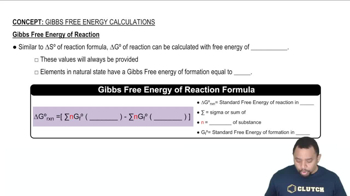
Gibbs Free Energy (ΔG)

Gibbs Free Energy (ΔG) is a thermodynamic potential that measures the maximum reversible work obtainable from a thermodynamic system at constant temperature and pressure. It is a crucial indicator of the spontaneity of a reaction; a negative ΔG suggests that a reaction can occur spontaneously, while a positive ΔG indicates non-spontaneity.
추천 영상:
가이드 코스
01:51
Gibbs Free Energy of Reactions

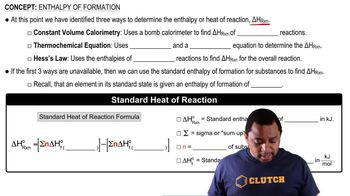
Enthalpy (ΔH)

Enthalpy (ΔH) is a measure of the total heat content of a system. It reflects the energy required to break and form bonds during a chemical reaction. In the context of Gibbs Free Energy, ΔH contributes to the overall energy change, influencing whether a reaction is exothermic or endothermic, which can affect the spontaneity of the reaction.
추천 영상:
가이드 코스
02:34
Enthalpy of Formation

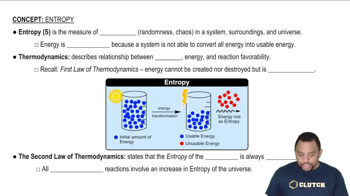
Entropy (ΔS)

Entropy (ΔS) is a measure of the disorder or randomness in a system. In thermodynamics, it plays a critical role in determining the spontaneity of a reaction. Generally, an increase in entropy (positive ΔS) favors spontaneity, and in many cases, the contribution of entropy to ΔG is considered more significant than that of enthalpy, especially at higher temperatures.
추천 영상:
가이드 코스
02:46
Entropy in Thermodynamics