Ch.9 - Thermochemistry: Chemical Energy
McMurry - Chemistry 8th Edition
McMurry8th EditionChemistryISBN: 9781292336145당신이 사용하는 게 아니라요?교과서 변경
9장, 문제 154

Hydrazine, a component of rocket fuel, undergoes combus- tion to yield N2 and H2O: N2H41l2 + O21g2 S N21g2 + 2 H2O1l2 (b) Use the following information to set up a Hess's law cycle, and then calculate ΔH° for the combustion reac- tion. You will need to use fractional coefficients for some equations. 2 NH31g2 + 3 N2O1g2 S 4 N21g2 + 3 H2O1l2 ΔH° = - 1011.2 kJ N2O1g2 + 3 H21g2 S N2H41l2 + H2O1l2 ΔH° = - 317.2 kJ 4 NH31g2 + O21g2 S 2 N2H41l2 + 2 H2O1l2 ΔH° = - 286.0 kJ H2O1l2 ΔH°f = - 285.8 kJ>mol

검증된 단계별 안내
1
Identify the target reaction: N_2H_4(l) + O_2(g) \(\rightarrow\) N_2(g) + 2 H_2O(l).
Write the given reactions and their enthalpy changes: (1) 2 NH_3(g) + 3 N_2O(g) \(\rightarrow\) 4 N_2(g) + 3 H_2O(l), \(\Delta\) H^\(\circ\) = -1011.2 \(\text{ kJ}\); (2) N_2O(g) + 3 H_2(g) \(\rightarrow\) N_2H_4(l) + H_2O(l), \(\Delta\) H^\(\circ\) = -317.2 \(\text{ kJ}\); (3) 4 NH_3(g) + O_2(g) \(\rightarrow\) 2 N_2H_4(l) + 2 H_2O(l), \(\Delta\) H^\(\circ\) = -286.0 \(\text{ kJ}\).
Use Hess's Law to manipulate the given reactions to derive the target reaction. This involves reversing and/or scaling the reactions to match the target reaction's stoichiometry.
Reverse reaction (2) to get N_2H_4(l) + H_2O(l) \(\rightarrow\) N_2O(g) + 3 H_2(g), and change the sign of \(\Delta\) H^\(\circ\) to +317.2 \(\text{ kJ}\).
Combine the manipulated reactions to cancel out intermediates and obtain the target reaction, then sum the \(\Delta\) H^\(\circ\) values to find the \(\Delta\) H^\(\circ\) for the target reaction.

비슷한 문제에 대한 검증된 영상 답변:

이 영상 해법은 위 문제에 도움이 된다고 튜터들이 추천한 것입니다.
영상 길이:
5m

주요 개념

질문에 올바르게 답하기 위해 반드시 이해해야 하는 핵심 개념들은 다음과 같습니다.

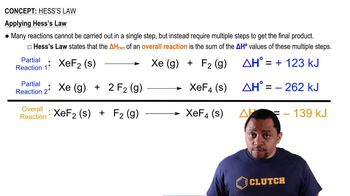
Hess's Law

Hess's Law states that the total enthalpy change for a chemical reaction is the same, regardless of the number of steps taken to complete the reaction. This principle allows chemists to calculate the enthalpy change of a reaction by using known enthalpy changes of other reactions, facilitating the determination of ΔH° for complex reactions like combustion.
추천 영상:

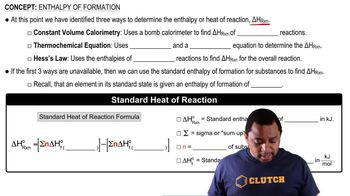
Standard Enthalpy of Formation (ΔH°f)

The standard enthalpy of formation (ΔH°f) is the change in enthalpy when one mole of a compound is formed from its elements in their standard states. This value is crucial for calculating the enthalpy change of reactions using Hess's Law, as it provides a reference point for the energy content of reactants and products.
추천 영상:
가이드 코스
02:34
Enthalpy of Formation

Combustion Reaction

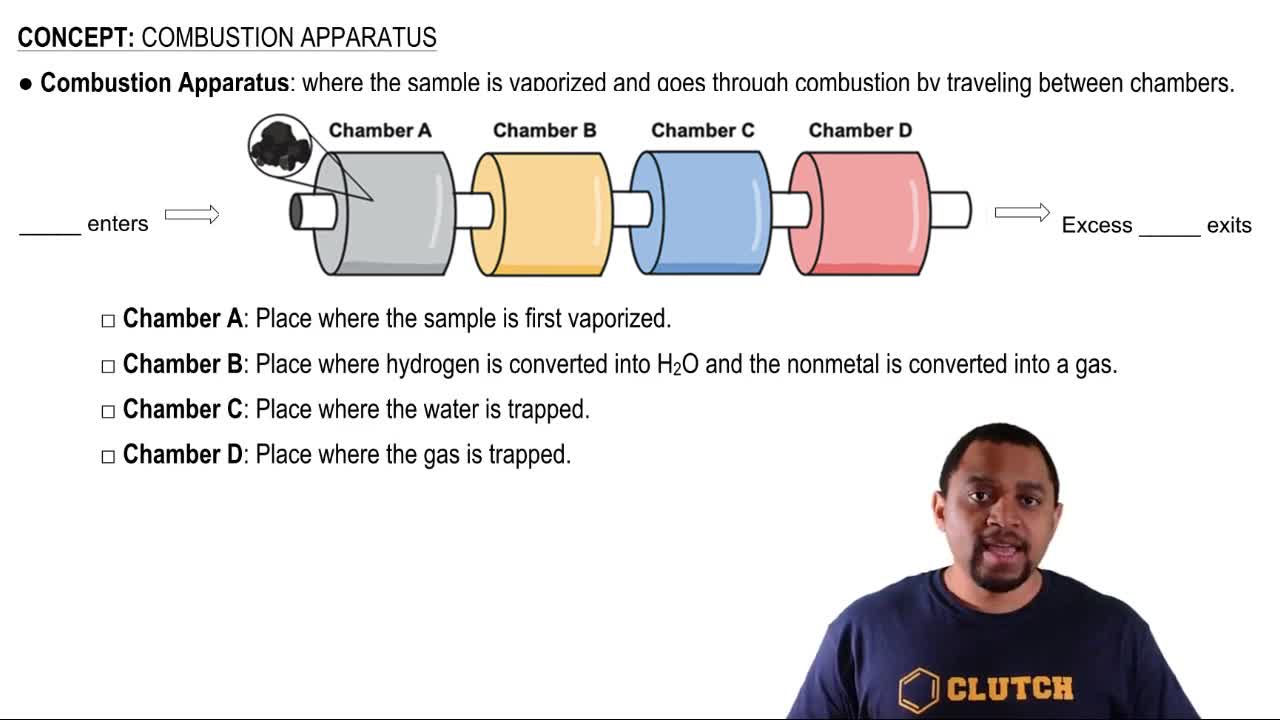
A combustion reaction is a chemical process in which a substance reacts rapidly with oxygen, producing heat and light. In the case of hydrazine, the combustion reaction yields nitrogen gas (N2) and water (H2O), and understanding the stoichiometry and enthalpy changes associated with this reaction is essential for calculating the overall energy release during combustion.
추천 영상:
가이드 코스
02:24
Combustion Apparatus