Ch.9 - Thermochemistry: Chemical Energy
McMurry - Chemistry 8th Edition
McMurry8th EditionChemistryISBN: 9781292336145당신이 사용하는 게 아니라요?교과서 변경
9장, 문제 155

Reaction of gaseous fluorine with compound X yields a sin- gle product Y, whose mass percent composition is 61.7% F and 38.3% Cl. (c) Calculate ΔH° for the synthesis of Y using the following information: 2 CIF1g2 + O21g2 S Cl2O1g2 + OF21g2 ΔH° = + 205.4 kJ 2 CIF31l2 + 2 O21g2 S Cl2O1g2 + 3 OF21g2 ΔH° = + 532.8 kJ OF21g2 ΔH°f = + 24.5 kJ>mol

검증된 단계별 안내
1
Identify the chemical formula of compound Y based on its mass percent composition: 61.7% F and 38.3% Cl. This suggests the formula is ClF3.
Write the balanced chemical equation for the formation of ClF3 from its elements: Cl2(g) + 3F2(g) -> 2ClF3(g).
Use Hess's Law to calculate the enthalpy change (ΔH°) for the formation of ClF3. This involves manipulating the given reactions to derive the desired reaction.
Reverse the first given reaction to express Cl2O and OF2 as reactants, and adjust the enthalpy change accordingly: Cl2O(g) + OF2(g) -> 2ClF(g) + O2(g), ΔH° = -205.4 kJ.
Combine the reversed first reaction and the second given reaction to eliminate intermediates and obtain the formation reaction of ClF3. Calculate the overall ΔH° using the enthalpy changes of the manipulated reactions.

비슷한 문제에 대한 검증된 영상 답변:

이 영상 해법은 위 문제에 도움이 된다고 튜터들이 추천한 것입니다.
영상 길이:
7m

주요 개념

질문에 올바르게 답하기 위해 반드시 이해해야 하는 핵심 개념들은 다음과 같습니다.

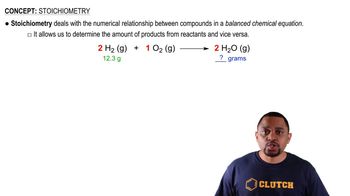
Stoichiometry

Stoichiometry is the calculation of reactants and products in chemical reactions based on the conservation of mass. It involves using balanced chemical equations to determine the relationships between the amounts of substances consumed and produced. Understanding stoichiometry is essential for calculating the quantities needed for reactions and for interpreting the results of chemical equations.
추천 영상:
가이드 코스
01:16
Stoichiometry Concept

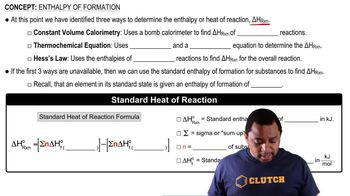
Enthalpy Change (ΔH°)

Enthalpy change (ΔH°) refers to the heat content change during a chemical reaction at constant pressure. It indicates whether a reaction is exothermic (releases heat, ΔH° < 0) or endothermic (absorbs heat, ΔH° > 0). Knowing the enthalpy changes of related reactions allows for the application of Hess's law, which states that the total enthalpy change for a reaction is the sum of the enthalpy changes for individual steps.
추천 영상:
가이드 코스
02:34
Enthalpy of Formation

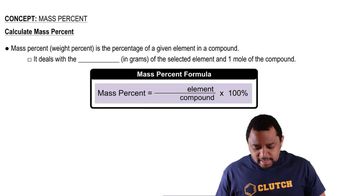
Mass Percent Composition

Mass percent composition is a way to express the concentration of an element in a compound as a percentage of the total mass of the compound. It is calculated by dividing the mass of the element by the total mass of the compound and multiplying by 100. This concept is crucial for determining the empirical formula of a compound and for understanding the proportions of elements involved in chemical reactions.
추천 영상:
가이드 코스
00:38
Mass Percent Calculation