Ch.9 - Thermochemistry: Chemical Energy
McMurry - Chemistry 8th Edition
McMurry8th EditionChemistryISBN: 9781292336145당신이 사용하는 게 아니라요?교과서 변경
9장, 문제 38a

The reaction of A with B to give D proceeds in two steps: (1) A + B → C ΔH° = -20 kJ (2) C + B → D ΔH° = +50 kJ (3) A + 2B → D ΔH° = ? (a) Which Hess's law diagram represents the reaction steps and the overall reaction? Diagram 1 Diagram 2

검증된 단계별 안내
1
Identify the individual reactions and their respective enthalpy changes given in the problem. The first reaction is A + B → C with an enthalpy change ΔH° = -20 kJ. The second reaction is C + B → D with an enthalpy change ΔH° = +50 kJ.
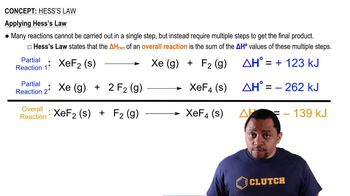
Understand that Hess's Law states that the total enthalpy change for a reaction is the sum of the enthalpy changes for any set of steps that leads from the reactants to the products. This means you can add the enthalpy changes of the steps to find the overall enthalpy change for the reaction A + 2B → D.
Add the enthalpy changes of the two steps. Since the first step has an enthalpy change of -20 kJ and the second step has an enthalpy change of +50 kJ, sum these values to find the overall enthalpy change for the reaction A + 2B → D.
Choose the correct Hess's law diagram that represents the given reactions and the overall reaction. The diagram should show the first reaction leading to the formation of C, the second reaction using C to form D, and the overall reaction directly forming D from A and 2B.
Verify that the diagram correctly aligns with the steps and the enthalpy changes provided, ensuring that it visually represents the sum of the enthalpy changes from the individual steps to the overall reaction.

비슷한 문제에 대한 검증된 영상 답변:

이 영상 해법은 위 문제에 도움이 된다고 튜터들이 추천한 것입니다.
영상 길이:
2m

주요 개념

질문에 올바르게 답하기 위해 반드시 이해해야 하는 핵심 개념들은 다음과 같습니다.

Hess's Law

Hess's Law states that the total enthalpy change for a chemical reaction is the sum of the enthalpy changes for the individual steps of the reaction, regardless of the pathway taken. This principle allows chemists to calculate the overall enthalpy change for a reaction by adding the enthalpy changes of each step, making it essential for analyzing multi-step reactions.
추천 영상:

Enthalpy Change (ΔH)

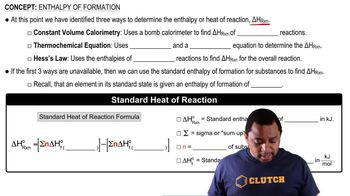
Enthalpy change (ΔH) is a measure of the heat content of a system at constant pressure. A negative ΔH indicates an exothermic reaction, where heat is released, while a positive ΔH indicates an endothermic reaction, where heat is absorbed. Understanding these changes is crucial for predicting the energy dynamics of chemical reactions.
추천 영상:
가이드 코스
02:34
Enthalpy of Formation

Reaction Mechanism

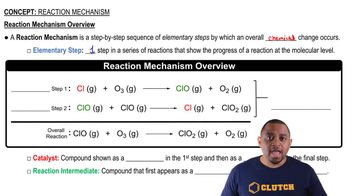
A reaction mechanism describes the step-by-step sequence of elementary reactions by which overall chemical change occurs. Each step has its own rate and enthalpy change, and understanding the mechanism helps in visualizing how reactants are converted to products, which is vital for applying Hess's Law to find the overall reaction enthalpy.
추천 영상:
가이드 코스
03:06
Reaction Mechanism Overview