Ch.9 - Thermochemistry: Chemical Energy
McMurry - Chemistry 8th Edition
McMurry8th EditionChemistryISBN: 9781292336145당신이 사용하는 게 아니라요?교과서 변경
9장, 문제 136

Which of the reactions (a)–(d) in Problem 9.132 are spontaneous at all temperatures, which are nonspontaneous at all temperatures, and which have an equilibrium temperature?

검증된 단계별 안내
1
Step 1: Recall the Gibbs free energy equation, \( \Delta G = \Delta H - T\Delta S \), where \( \Delta G \) is the change in Gibbs free energy, \( \Delta H \) is the change in enthalpy, \( T \) is the temperature in Kelvin, and \( \Delta S \) is the change in entropy.
Step 2: Understand that a reaction is spontaneous at all temperatures if \( \Delta H < 0 \) and \( \Delta S > 0 \), because \( \Delta G \) will be negative regardless of the temperature.
Step 3: Recognize that a reaction is nonspontaneous at all temperatures if \( \Delta H > 0 \) and \( \Delta S < 0 \), because \( \Delta G \) will be positive regardless of the temperature.
Step 4: Identify that a reaction has an equilibrium temperature if \( \Delta H \) and \( \Delta S \) have the same sign. Calculate the equilibrium temperature using \( T = \frac{\Delta H}{\Delta S} \) when \( \Delta G = 0 \).
Step 5: Apply these criteria to each reaction (a)–(d) from Problem 9.132 to determine their spontaneity at different temperatures.

주요 개념

질문에 올바르게 답하기 위해 반드시 이해해야 하는 핵심 개념들은 다음과 같습니다.

Spontaneity of Reactions

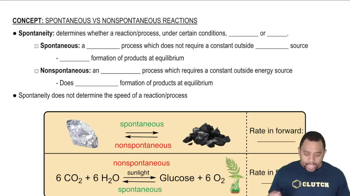
The spontaneity of a reaction refers to whether a reaction can occur without external intervention. A reaction is spontaneous if it leads to an increase in the entropy of the universe, which is often assessed using Gibbs free energy. If the change in Gibbs free energy (ΔG) is negative, the reaction is spontaneous; if positive, it is nonspontaneous.
추천 영상:
가이드 코스
04:20
Spontaneity of Processes

Gibbs Free Energy

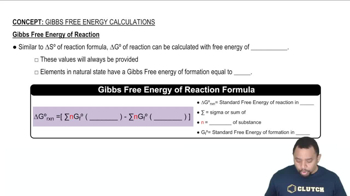
Gibbs free energy (G) is a thermodynamic potential that helps predict the direction of chemical reactions. It combines enthalpy (H) and entropy (S) into the equation ΔG = ΔH - TΔS, where T is the temperature in Kelvin. A negative ΔG indicates a spontaneous process, while a positive ΔG suggests nonspontaneity. The equilibrium temperature occurs when ΔG equals zero.
추천 영상:
가이드 코스
01:51
Gibbs Free Energy of Reactions

Equilibrium Temperature

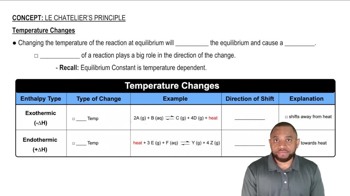
The equilibrium temperature is the specific temperature at which a reaction shifts from being spontaneous to nonspontaneous, or vice versa. At this temperature, the Gibbs free energy change (ΔG) is zero, indicating that the forward and reverse reactions occur at the same rate. This concept is crucial for understanding how temperature influences reaction spontaneity.
추천 영상:
가이드 코스
04:04
Temperature and Equilibrium Shifts