Ch.12 - Solids and Modern Material
Tro - Chemistry: A Molecular Approach 4th Edition
Tro4th EditionChemistry: A Molecular ApproachISBN: 9780134112831당신이 사용하는 게 아니라요?교과서 변경
12장, 문제 52

Consider the zinc blende structure in Figure 12.16. What type of structure would result if the remaining tetrahedral sites in the unit cell were also filled with cations?

검증된 단계별 안내
1
Identify the zinc blende structure: The zinc blende (ZnS) structure is a type of face-centered cubic (fcc) lattice where the anions (S) form the fcc lattice and the cations (Zn) occupy half of the tetrahedral sites.
Understand the tetrahedral sites: In a face-centered cubic lattice, there are eight tetrahedral sites per unit cell. In the zinc blende structure, only half of these sites are occupied by cations.
Consider filling all tetrahedral sites: If all tetrahedral sites in the unit cell are filled with cations, this means that instead of having only half of the tetrahedral sites occupied, all eight sites will be occupied.
Determine the resulting structure: When all tetrahedral sites are filled, the structure becomes similar to the antifluorite structure, where the cations fully occupy the tetrahedral sites in an anion fcc lattice.
Conclude the type of structure: The resulting structure, with all tetrahedral sites filled with cations, is analogous to the antifluorite structure, which is the inverse of the fluorite structure where anions occupy the tetrahedral sites in a cation fcc lattice.

주요 개념

질문에 올바르게 답하기 위해 반드시 이해해야 하는 핵심 개념들은 다음과 같습니다.

Zinc Blende Structure

The zinc blende structure, also known as sphalerite, is a type of crystal lattice where zinc (Zn) cations are tetrahedrally coordinated by sulfur (S) anions. This structure is characterized by a face-centered cubic arrangement of anions with cations occupying half of the tetrahedral sites. Understanding this arrangement is crucial for predicting how additional cations would affect the overall structure.
추천 영상:
가이드 코스
01:42
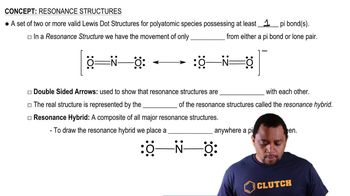
Resonance Structures

Tetrahedral Sites

Tetrahedral sites in a crystal lattice are positions where cations can be located, surrounded by four anions at the corners of a tetrahedron. In the zinc blende structure, each unit cell contains tetrahedral sites that can accommodate additional cations. Filling these sites alters the stoichiometry and can lead to different structural properties, which is essential for understanding the implications of the question.
추천 영상:
가이드 코스
01:38
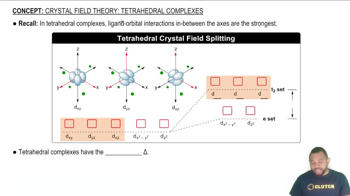
The crystal field splitting pattern for tetrahedral complexes has the d orbitals in between the axes as having the higher energy.

Crystal Structure Modification

When additional cations occupy the tetrahedral sites in a crystal structure, it can lead to a new phase or modification of the existing structure. This can result in changes to the material's properties, such as conductivity, stability, and reactivity. In the case of zinc blende, filling all tetrahedral sites could lead to a structure similar to that of a different compound, such as a spinel structure, which has distinct characteristics.
추천 영상:
가이드 코스
01:42
Resonance Structures