Ch.12 - Solids and Modern Material
Tro - Chemistry: A Molecular Approach 4th Edition
Tro4th EditionChemistry: A Molecular ApproachISBN: 9780134112831당신이 사용하는 게 아니라요?교과서 변경
12장, 문제 40a

Identify each solid as molecular, ionic, or atomic. a. CaCl2(s)

검증된 단계별 안내
1
Identify the type of elements involved in the compound CaCl_2.
Recognize that calcium (Ca) is a metal and chlorine (Cl) is a non-metal.
Understand that when a metal and a non-metal combine, they typically form an ionic compound.
Recall that ionic compounds are composed of cations and anions held together by electrostatic forces.
Conclude that CaCl_2 is an ionic solid because it consists of Ca^2+ cations and Cl^- anions.

비슷한 문제에 대한 검증된 영상 답변:

이 영상 해법은 위 문제에 도움이 된다고 튜터들이 추천한 것입니다.
영상 길이:
1m
도움이 되었나요?

주요 개념

질문에 올바르게 답하기 위해 반드시 이해해야 하는 핵심 개념들은 다음과 같습니다.

Ionic Compounds

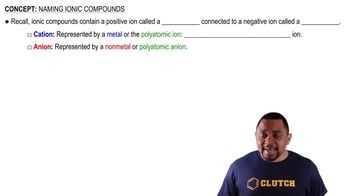
Ionic compounds are formed when atoms transfer electrons, resulting in the formation of charged ions. These compounds typically consist of a metal and a non-metal, where the metal loses electrons to become a positively charged cation, and the non-metal gains electrons to become a negatively charged anion. Calcium chloride (CaCl2) is an example of an ionic compound, as it consists of calcium ions (Ca²⁺) and chloride ions (Cl⁻) held together by strong electrostatic forces.
추천 영상:
가이드 코스
02:11
Ionic Compounds Naming

Molecular Solids

Molecular solids are composed of molecules held together by intermolecular forces such as van der Waals forces, hydrogen bonds, or dipole-dipole interactions. These solids typically have lower melting and boiling points compared to ionic or atomic solids due to the weaker forces between the molecules. Examples include ice (solid water) and sugar, which consist of discrete molecules rather than ions or atoms.
추천 영상:
가이드 코스
04:13
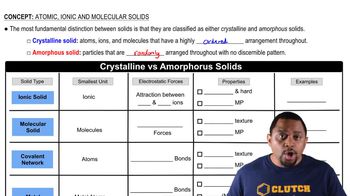
Crystalline vs Amorphous Solids

Atomic Solids

Atomic solids are composed of atoms held together by covalent bonds, forming a network structure. These solids exhibit high melting points and are often very hard due to the strong bonding between atoms. Diamond and silicon are classic examples of atomic solids, where each atom is bonded to several others in a three-dimensional lattice, resulting in their characteristic properties.
추천 영상:
가이드 코스
04:13
Crystalline vs Amorphous Solids