
Ch.1 - Matter, Measurement & Problem Solving
Tro - Chemistry: A Molecular Approach 4th Edition
Tro4th EditionChemistry: A Molecular ApproachISBN: 9780134112831당신이 사용하는 게 아니라요?교과서 변경
1장, 문제 9

Calculate the density of a liquid in g/mL to the correct number of significant digits, if a flask containing 9.55 mL of the liquid weighs 157.2 g with the liquid and 148.4 g when empty.

검증된 단계별 안내
1
Calculate the mass of the liquid by subtracting the mass of the empty flask from the mass of the flask with the liquid: \( m_{\text{liquid}} = m_{\text{flask with liquid}} - m_{\text{empty flask}} \).
Substitute the given values into the equation: \( m_{\text{liquid}} = 157.2\, \text{g} - 148.4\, \text{g} \).
Determine the volume of the liquid, which is given as 9.55 mL.
Use the formula for density: \( \text{Density} = \frac{\text{mass}}{\text{volume}} \).
Substitute the mass of the liquid and the volume into the density formula to find the density in g/mL, ensuring the answer is reported with the correct number of significant figures.

주요 개념

질문에 올바르게 답하기 위해 반드시 이해해야 하는 핵심 개념들은 다음과 같습니다.

Density

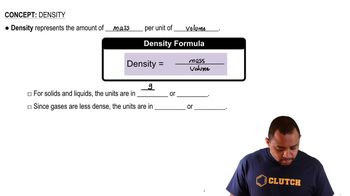
Density is defined as the mass of a substance divided by its volume, typically expressed in grams per milliliter (g/mL) for liquids. It is a crucial physical property that helps identify substances and can indicate purity. The formula for density is D = m/V, where D is density, m is mass, and V is volume.
추천 영상:
가이드 코스
01:56
Density Concepts

Significant Figures

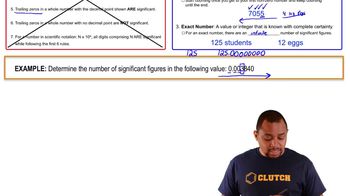
Significant figures are the digits in a number that contribute to its precision. This includes all non-zero digits, any zeros between significant digits, and trailing zeros in the decimal portion. When performing calculations, the result should be reported with the same number of significant figures as the measurement with the least number of significant figures to maintain accuracy.
추천 영상:
가이드 코스
01:09
Significant Figures Example

Mass Calculation

To find the mass of the liquid in the flask, subtract the mass of the empty flask from the total mass of the flask with the liquid. This calculation is essential for determining the mass component needed to calculate density. In this case, the mass of the liquid is 157.2 g (total) - 148.4 g (empty) = 8.8 g.
추천 영상:
가이드 코스
03:12
Molar Mass Calculation Example