Determine the electron geometry, molecular geometry, and idealized bond angles for each molecule. In which cases do you expect deviations from the idealized bond angle? a. CF4 b. NF3 c. OF2 d. H2S
Ch.10 - Chemical Bonding II: Molecular Shapes & Valence Bond Theory
10장, 문제 39
Determine the molecular geometry and sketch each molecule or ion using the bond conventions shown in “Representing Molecular Geometries on Paper” in Section 10.4 for the following: a. SF4 b. ClF3.
검증된 단계별 안내1
Step 1: Determine the total number of valence electrons for each molecule.
Step 2: Draw the Lewis structure for each molecule, ensuring that all atoms satisfy the octet rule where applicable.
Step 3: Use the VSEPR (Valence Shell Electron Pair Repulsion) theory to determine the electron pair geometry around the central atom.
Step 4: Identify the molecular geometry based on the arrangement of bonding pairs and lone pairs around the central atom.
Step 5: Sketch the molecular geometry using the bond conventions, indicating the positions of atoms and lone pairs.
주요 개념
질문에 올바르게 답하기 위해 반드시 이해해야 하는 핵심 개념들은 다음과 같습니다.
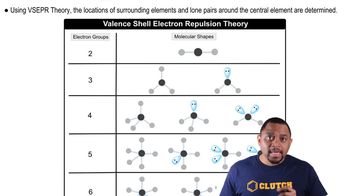
VSEPR Theory
Valence Shell Electron Pair Repulsion (VSEPR) Theory is a model used to predict the geometry of individual molecules based on the repulsion between electron pairs in the valence shell of the central atom. According to VSEPR, electron pairs will arrange themselves as far apart as possible to minimize repulsion, leading to specific molecular shapes. This theory is essential for determining the 3D arrangement of atoms in molecules like SF4 and ClF3.
추천 영상:
가이드 코스
Molecular Shapes and VSEPR
Molecular Geometry
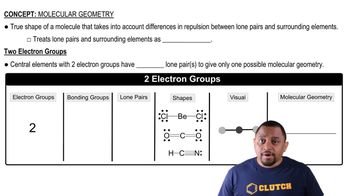
Molecular geometry refers to the three-dimensional arrangement of atoms within a molecule. It is determined by the number of bonding pairs and lone pairs of electrons around the central atom. Understanding molecular geometry is crucial for predicting the physical and chemical properties of a substance, as well as its reactivity and interaction with other molecules.
추천 영상:
가이드 코스
Molecular Geometry with Two Electron Groups
Bonding Conventions
Bonding conventions are standardized methods used to represent molecular structures on paper, including the use of lines to depict bonds and symbols for lone pairs. These conventions help in visualizing the arrangement of atoms and the types of bonds (single, double, or triple) present in a molecule. Familiarity with these conventions is necessary for accurately sketching molecular geometries as required in the question.
추천 영상:
가이드 코스
Bond Angles
관련 실천
교과서 질문
1172
views
교과서 질문
Determine the molecular geometry and sketch each molecule or ion using the bond conventions shown in 'Representing Molecular Geometries on Paper' in Section 10.4. c. IF2-
469
views
교과서 질문
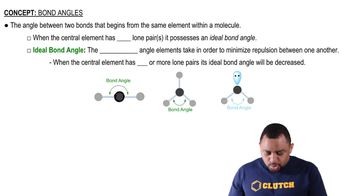
Which species has the smaller bond angle, ClO4- or ClO3- ? Explain.
998
views
교과서 질문
Determine the molecular geometry and sketch each molecule or ion, using the bond conventions shown in 'Representing Molecular Geometries on Paper' in Section 10.4. b. SCl6
543
views
교과서 질문
Which species has the smaller bond angle, H3O+ or H2O? Explain.
1068
views
교과서 질문
Determine the molecular geometry and sketch each molecule or ion using the bond conventions shown in 'Representing Molecular Geometries on Paper' in Section 10.4. d. IBr4-
778
views