Ch.11 - Liquids, Solids & Intermolecular Forces
Tro - Chemistry: A Molecular Approach 4th Edition
Tro4th EditionChemistry: A Molecular ApproachISBN: 9780134112831당신이 사용하는 게 아니라요?교과서 변경
11장, 문제 51c

Determine whether each molecule is polar or nonpolar. c. BrCl5

검증된 단계별 안내
1
Identify the molecular geometry of BrCl5 using VSEPR theory. Since bromine (Br) is the central atom with five chlorine (Cl) atoms and one lone pair, the molecular geometry is square pyramidal.
Analyze the electronegativity of the atoms involved. Chlorine is more electronegative than bromine, creating polar bonds between each Br and Cl.
Consider the molecular geometry to determine if the polarities of the bonds cancel out. In a square pyramidal shape, the symmetry is not enough to cancel out the dipole moments of the polar Br-Cl bonds.
Conclude that due to the presence of polar bonds and a molecular geometry that does not allow for symmetry to cancel these dipoles, BrCl5 is a polar molecule.
Understand that the overall polarity of a molecule affects its physical properties such as boiling point, solubility, and interactions with other molecules.

비슷한 문제에 대한 검증된 영상 답변:

이 영상 해법은 위 문제에 도움이 된다고 튜터들이 추천한 것입니다.
영상 길이:
3m
도움이 되었나요?

주요 개념

질문에 올바르게 답하기 위해 반드시 이해해야 하는 핵심 개념들은 다음과 같습니다.

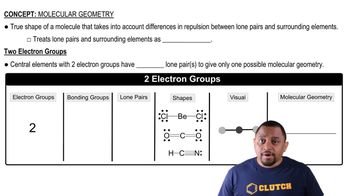
Molecular Geometry

Molecular geometry refers to the three-dimensional arrangement of atoms within a molecule. The shape of a molecule is determined by the number of bonding pairs and lone pairs of electrons around the central atom, which influences the distribution of charge and ultimately the polarity of the molecule.
추천 영상:
가이드 코스
01:33
Molecular Geometry with Two Electron Groups

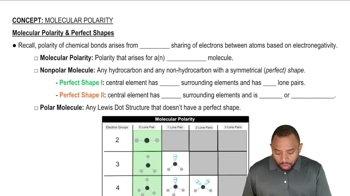
Polarity

Polarity in chemistry describes the distribution of electrical charge over the atoms in a molecule. A molecule is polar if it has a significant difference in electronegativity between its atoms, leading to a dipole moment, while nonpolar molecules have an even distribution of charge, often due to symmetrical arrangements.
추천 영상:
가이드 코스
02:38
Molecular Polarity

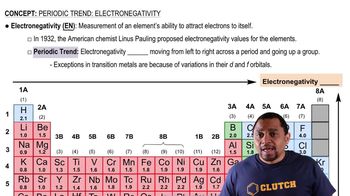
Electronegativity

Electronegativity is a measure of an atom's ability to attract and hold onto electrons within a bond. In determining molecular polarity, the difference in electronegativity between bonded atoms helps predict whether the bond will be polar or nonpolar, influencing the overall polarity of the molecule.
추천 영상:
가이드 코스
02:10
Electronegativity Trends