An aqueous NaCl solution is made using 112 g of NaCl diluted to a total solution volume of 1.00 L. Calculate the mass percent of the solution. (Assume a density of 1.08 g/mL for the solution.)
Ch.13 - Solutions
13장, 문제 49
Calculate the mass of nitrogen dissolved at room temperature in an 80.0-L home aquarium, assuming a total pressure of 1.0 atm and a mole fraction for nitrogen of 0.78.
검증된 단계별 안내1
Identify the relevant law: Use Henry's Law, which states that the solubility of a gas in a liquid is directly proportional to the partial pressure of the gas above the liquid.
Calculate the partial pressure of nitrogen: Multiply the total pressure by the mole fraction of nitrogen, i.e., \( P_{\text{N}_2} = 1.0 \text{ atm} \times 0.78 \).
Use Henry's Law to find the concentration of nitrogen: \( C = k_H \times P_{\text{N}_2} \), where \( k_H \) is the Henry's Law constant for nitrogen at room temperature.
Determine the volume of water in the aquarium: Since the aquarium is 80.0 L, assume this is the volume of water available for dissolving nitrogen.
Calculate the mass of nitrogen: Use the concentration from Henry's Law and the volume of water to find the moles of nitrogen, then convert moles to mass using the molar mass of nitrogen (28.02 g/mol).
주요 개념
질문에 올바르게 답하기 위해 반드시 이해해야 하는 핵심 개념들은 다음과 같습니다.
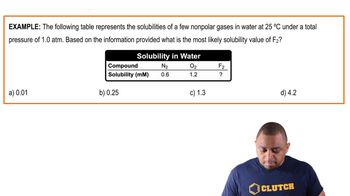
Gas Solubility
Gas solubility refers to the amount of gas that can dissolve in a liquid at a given temperature and pressure. This is influenced by factors such as the nature of the gas, the solvent, and the temperature. For gases, solubility often increases with pressure, following Henry's Law, which states that the amount of gas dissolved is proportional to its partial pressure above the liquid.
추천 영상:
가이드 코스
Gas Solubility Example
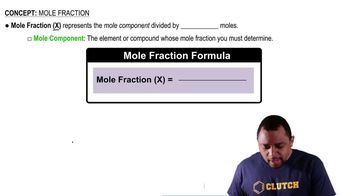
Mole Fraction
Mole fraction is a way of expressing the concentration of a component in a mixture. It is defined as the ratio of the number of moles of a specific component to the total number of moles of all components in the mixture. In this context, the mole fraction of nitrogen indicates its proportion in the gas phase, which helps in calculating the partial pressure and subsequently the amount of nitrogen that can dissolve in the aquarium water.
추천 영상:
가이드 코스
Mole Fraction Formula
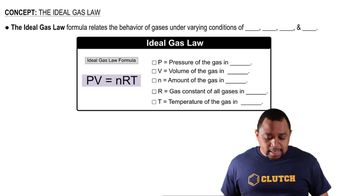
Ideal Gas Law
The Ideal Gas Law is a fundamental equation in chemistry that relates the pressure, volume, temperature, and number of moles of an ideal gas. It is expressed as PV = nRT, where P is pressure, V is volume, n is the number of moles, R is the ideal gas constant, and T is temperature in Kelvin. This law is essential for calculating the number of moles of nitrogen in the aquarium based on the given pressure and volume, which can then be used to determine the mass of nitrogen dissolved.
추천 영상:
가이드 코스
Ideal Gas Law Formula
관련 실천
교과서 질문
551
views
교과서 질문
An aqueous NaCl solution is made using 112 g of NaCl diluted to a total solution volume of 1.00 L. Calculate the molarity of the solution. (Assume a density of 1.08 g/mL for the solution.)
621
views
교과서 질문
An aqueous NaCl solution is made using 112 g of NaCl diluted to a total solution volume of 1.00 L. Calculate the molality of the solution. (Assume a density of 1.08 g/mL for the solution.)
2637
views
교과서 질문
Scuba divers breathing air at increased pressure can suffer from oxygen toxicity—too much oxygen in their bloodstream— when the partial pressure of oxygen exceeds about 1.4 atm. What happens to the amount of oxygen in a diver's bloodstream when he or she breathes oxygen at elevated pressures? How can this be reversed?
1102
views