Ch.13 - Solutions
Tro - Chemistry: A Molecular Approach 4th Edition
Tro4th EditionChemistry: A Molecular ApproachISBN: 9780134112831당신이 사용하는 게 아니라요?교과서 변경
13장, 문제 29

Pick an appropriate solvent from Table 13.3 to dissolve each substance. State the kind of intermolecular forces that would occur between the solute and solvent in each case. a. motor oil (nonpolar) b. ethanol (polar, contains an OH group) c. lard (nonpolar) d. potassium chloride (ionic)

검증된 단계별 안내
1
Identify the nature of each solute: motor oil and lard are nonpolar, ethanol is polar with an OH group, and potassium chloride is ionic.
Refer to Table 13.3 to find solvents that match the polarity or ionic nature of each solute. Remember the principle 'like dissolves like'.
For nonpolar solutes like motor oil and lard, choose a nonpolar solvent. The intermolecular forces involved are London dispersion forces.
For polar solutes like ethanol, choose a polar solvent that can form hydrogen bonds. The intermolecular forces involved are hydrogen bonding and dipole-dipole interactions.
For ionic solutes like potassium chloride, choose a polar solvent that can stabilize ions, such as water. The intermolecular forces involved are ion-dipole interactions.

비슷한 문제에 대한 검증된 영상 답변:

이 영상 해법은 위 문제에 도움이 된다고 튜터들이 추천한 것입니다.
영상 길이:
2m
도움이 되었나요?

주요 개념

질문에 올바르게 답하기 위해 반드시 이해해야 하는 핵심 개념들은 다음과 같습니다.

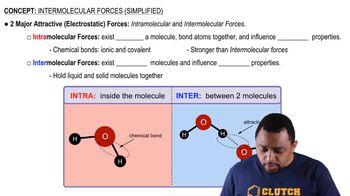
Intermolecular Forces

Intermolecular forces are the forces of attraction or repulsion between molecules. They include hydrogen bonding, dipole-dipole interactions, and London dispersion forces. Understanding these forces is crucial for predicting how substances will interact with each other, particularly in solutions, as they determine the solubility of solutes in solvents.
추천 영상:
가이드 코스
01:59
Intermolecular vs Intramolecular Forces

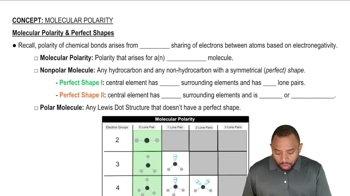
Polarity

Polarity refers to the distribution of electrical charge over the atoms in a molecule. Polar molecules, like ethanol, have a significant difference in electronegativity between their atoms, leading to partial positive and negative charges. Nonpolar molecules, such as motor oil and lard, have an even distribution of charge, which affects their solubility in different solvents and the types of intermolecular forces they can engage in.
추천 영상:
가이드 코스
02:38
Molecular Polarity

Solubility Principles

The principle of 'like dissolves like' states that polar solvents typically dissolve polar solutes, while nonpolar solvents dissolve nonpolar solutes. This principle is essential for selecting appropriate solvents for dissolving various substances, as it helps predict the interactions based on the nature of the solute and solvent, including the types of intermolecular forces that will be present.
추천 영상:
가이드 코스
02:05
Uncertainty Principle Formula