Ch.13 - Solutions
Tro - Chemistry: A Molecular Approach 4th Edition
Tro4th EditionChemistry: A Molecular ApproachISBN: 9780134112831당신이 사용하는 게 아니라요?교과서 변경
13장, 문제 36d

When lithium iodide (LiI) is dissolved in water, the solution becomes hotter. d. Why does the solution form? What drives the process?

검증된 단계별 안내
1
insert step 1> Understand that when lithium iodide (LiI) dissolves in water, it dissociates into lithium ions (Li^+) and iodide ions (I^-). This process involves breaking the ionic bonds in the solid and forming new interactions with water molecules.
insert step 2> Recognize that the dissolution process involves two main energy changes: the lattice energy of LiI and the hydration energy of the ions. Lattice energy is the energy required to separate the ions in the solid, while hydration energy is the energy released when ions interact with water molecules.
insert step 3> Note that the solution becomes hotter, indicating that the dissolution process is exothermic. This means that the energy released during hydration is greater than the energy required to break the lattice.
insert step 4> Consider the concept of entropy, which is a measure of disorder. When LiI dissolves, the system's entropy increases because the ions are more dispersed in solution than in the solid state.
insert step 5> Conclude that the solution forms because the overall process is driven by both the exothermic nature of the dissolution (enthalpy change) and the increase in entropy, making the process thermodynamically favorable.

비슷한 문제에 대한 검증된 영상 답변:

이 영상 해법은 위 문제에 도움이 된다고 튜터들이 추천한 것입니다.
영상 길이:
3m
도움이 되었나요?

주요 개념

질문에 올바르게 답하기 위해 반드시 이해해야 하는 핵심 개념들은 다음과 같습니다.

Dissolution Process

The dissolution process involves the breaking of ionic bonds in a solid solute and the interaction of solute ions with solvent molecules. In the case of lithium iodide (LiI), the ionic bonds between lithium and iodide ions are overcome by the interactions with water molecules, leading to the formation of a solution.
추천 영상:
가이드 코스
04:20
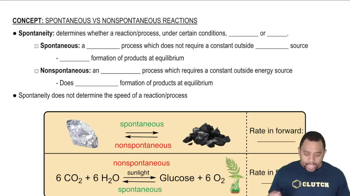
Spontaneity of Processes

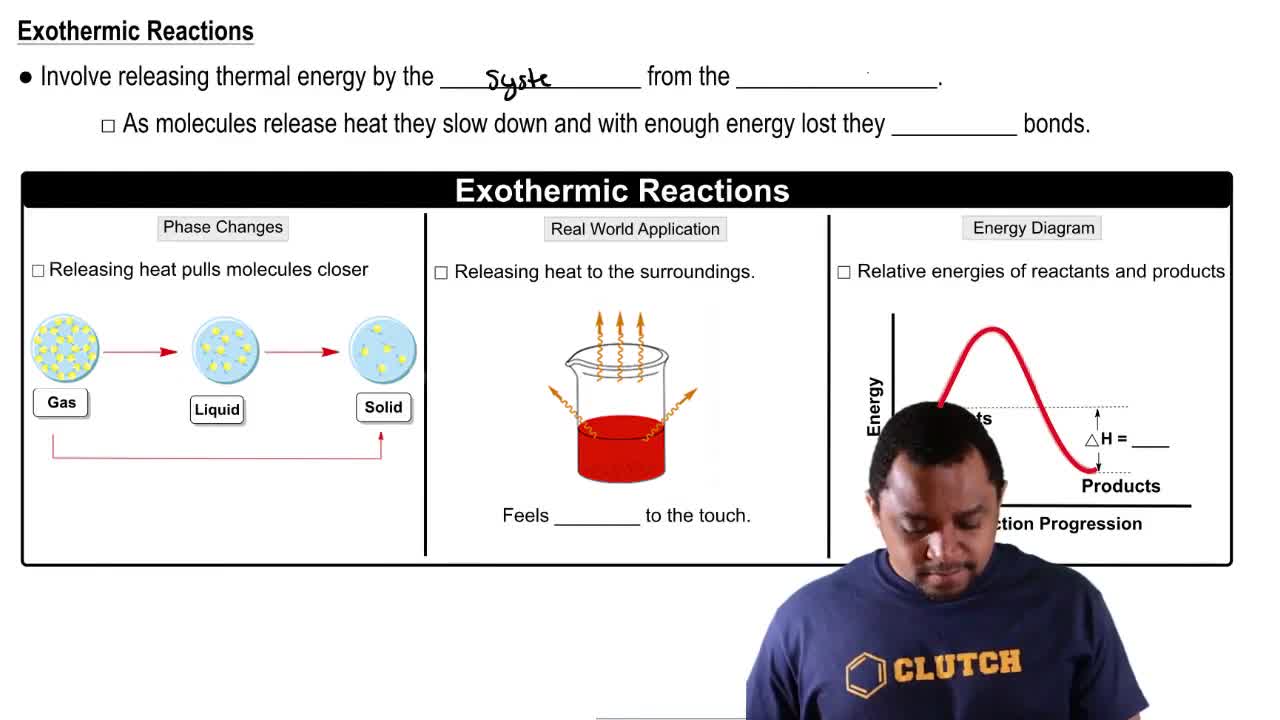
Exothermic Reactions

An exothermic reaction is a process that releases heat to the surroundings. When LiI dissolves in water, the energy released from the formation of ion-dipole interactions between the ions and water molecules is greater than the energy required to break the ionic bonds, resulting in an increase in temperature of the solution.
추천 영상:
가이드 코스
02:38
Endothermic & Exothermic Reactions

Thermodynamics of Solutions

The thermodynamics of solutions involves the concepts of enthalpy and entropy. The dissolution of LiI is driven by the overall change in Gibbs free energy, which combines enthalpic and entropic contributions. A negative Gibbs free energy indicates that the process is spontaneous, which is the case when LiI dissolves in water and releases heat.
추천 영상:
가이드 코스
01:18
First Law of Thermodynamics